Book now for 2016 Healthy Food Festivals

There are some delicious healthy food festivals in London but in our experience, they get booked out annoyingly quickly so we’re giving you the heads up on some great ones coming up later this year.

First off, in April health food producers Rude Health are taking over events at Whole Foods in Kensington.  There will be culinary workshops, demonstrations, yoga classes, running clubs and free tastings all month.  There will be also be an opportunity to hear from photographer Issy Croker, carve your own porridge spoon with Grain & Knot and and make some delicious nut smoothies with Pip & Nut.

At Goodroots on 11th June, you’ll find workshops, a food market and talks from the likes of Deliciously Ella, Hemsley & Hemsley, Rosemary Ferguson and Liberty London Girl.  You can buy a £10 ticket which gets you entry to the general food market and/or individual tickets to each talk.

Over in North London on the same day, the Fork to Fork Festival will also be under way.  Much more of a family festival, there will be live music, a bar and kids activities with the opportunity to sample food from lots of food producers and restaurants including Caravan, Granger & Co, Iberico, Ottolenghi, Polpo, Snaps & Rye, Moro, The Modern Pantry, The River Cafe, Wahaca and Tom’s Kitchen.  Set up by Thomasina Miers (of Wahaca) and Laura Harper-Hinton (of Caravan) last year, the festival raises money for the open air classroom project at ARK Franklin Primary in Kensal Rise.

Book now for 5 x 15 talks by Wellcome Prize shortlisted authors

The Wellcome Book Prize shortlist has just been announced and, true to form, there isn’t a dud choice on it. The prize celebrates new books – fiction and non-fiction – that explore some aspect of health, medicine or illness, and the shortlist is always incredibly wide-ranging and interesting: relevant to all of us in so many ways; essential reading in other words, and yet we find that  quite often we’ve missed some of the titles along the way.

This year’s list is made up of two novels (Playthings by Alex Pheby, and Signs for Lost Children by Sarah Moss), two memoirs (The Outrun by Amy Liptrot, about addiction, and The Last Act of Love by Cathy Rentzenbrink, about a devastating accident), and two works of non fiction (Neurotribes by Steve Silberman, which explores autism, and It’s All in Your Head by Suzanne O’Sullivan about psychosomatic illness). To explore the shortlist further, there are two events in which all the authors will discuss their work. We wouldn’t miss either. (We recently went to a talk about grief and families by Andrew Solomon and Marion Coutts, who won the prize in 2014 and 2015 respectively. It was totally brilliant).

The first is the Wellcome Book Prize Authors in Conversation on Saturday 23rd April, at the Wellcome Collection, which is on the Euston Road. At this event the authors, chaired by writer and sociologist Anne Karpf, will discuss their creative process and explore the broader context of medicine and literature.

The second is a 5 x 15 event (these are always great, and as a result have a loyal and large following, so sell out quickly), in which each author will deliver a 15 minute lecture on a subject relating to their book. This is on Sunday 24th April at 4pm, at The Tabernacle on Powis Square, just off Portobello Road.

Though the first event is free, you do need to book tickets for it as places are limited, and we recommend you do so now. Both events are bound to sell out fast.


An Easter Table – Petersham Nurseries style

Two of our (frequently written about) horticultural obsessions are Petersham Nurseries and its wonderful school of garden inspiration. So we headed there recently for a spring planter workshop with Thomas Broom-Hughes and enjoyed it so much that we had to share his tips for creating an Easter table. Needless to say, there is nothing minimal about this very Petersham décor – but many of these plants can be gathered from the garden or bought potted and then added to the garden afterwards so there’s no waste at all.

  1. Focus on a single colour – yellow is traditional for Easter and makes use of so many gorgeous spring flowers including narcissi, primroses and cowslips.
  2. Focus on one material – here zinc pots work really well with a zinc topped table but you can easily trade them for terracotta. Or use simple glasses or jam jars for cut flowers.
  3. Make a table runner with garden-gathered moss (you can buy this at garden centres) or, if you’re eating outside, you could even use rolls of turf.
  4. Create lots of different heights and shapes down the length of the table. Tall narcissi look fabulous with the sun shining through their petals.
  5. Finally weave through some lengths of ivy or other hedgerow foliage – blackthorn blossom is particularly pretty and in season now.

Happy Easter!

Catriona Gray on Decorating A Studio

In a world of flat-sharing, moving into a studio might seem like a strange choice, not helped by the cupboard-like properties you see listed on Rightmove. As a serial renter, I’d never considered it as an option until I started working on a series of interior-decoration books about House & Garden’s archives. In the 1950s and 1960s, studios were the place to have. Young, ambitious creatives flocked to London and rented a room that served as a space to live and work in. Each of them customised their interiors on a shoe-string, creating homes that were full of character. Bridget Riley made her studio in Earls Court entirely monochrome, Terence Conran filled his student flat full of furniture hand-crafted from tubular steel, while David Hockney enlivened his bedsit studio by cutting out trees from plywood and painting them bright green. Inspired by so many brilliant bedsit-dwellers, I found a studio in a Victorian terrace in Primrose Hill and moved in. That was nearly two years ago and I’ve loved every minute. Along the way, I learnt some lessons about how to make the most of a bedsit:

CURATE YOUR POSSESSIONS

This applies to any interior, but it’s even more essential in small spaces not to surround yourself with clutter. I’m not suggesting you channel Marie Kondo too rigorously: I’ve happily accumulated an assortment of art and antiques, while my collection of books has overflown from the shelves onto every available surface. However, my desire to live with the bare minimum of ugliness meant that I’ve thrown away many of the things that I had been mindlessly dragging about with me from flat to flat. I even got rid of my ironing board and drying rack because there wasn’t the space to store them. It does mean that my clothes are often draped over the towel rail, but that’s far better than having household equipment permanently lurking in a corner.

PAINTING THE WALLS

Tempting though it is to get carried away by the Farrow & Ball paint chart, if you’re renting it often pays to be conservative with the amount of redecorating you do – you never know how long you’ll end up staying there. If the walls are a particularly disgusting shade, there are few landlords who will object if you paint it white or a neutral colour (just check with them first). I was lucky in that the walls were already white, but the flat’s miniscule, dingy hallway looked awful. I ended up painting it in a deep emerald-blue from Emerie & Cie, and leaving the kitchen and main room white. Having a strong shot of colour in that central space really worked. Funnily enough, I subsequently learnt from Farrow & Ball’s chief colour consultant Joa Studholme that painting a hallway in a very dark colour is a common trick for creating atmosphere (her’s is in ‘Railings’).

DON’T HIDE YOUR BED

Studios only feel depressing if they’re trying to be something they’re not. To me, having a fold-up bed or a sofa-bed seems a little sad – as if you’re embarrassed by the lack of space or pretending that you don’t actually sleep there. I found it strange how practically all features on designing studios focus on concealing the bed, but it’s not conducive to comfortable living. Having spent months trying unsuccessfully to hide away my double bed, I gave up and stuck it right in the middle of the room. Immediately, the entire space looked immeasurably better. Instead of feeling like small bedsit, it now resembles very large bedroom.

TAKE SHORT CUTS

When I moved in, I needed to cover up a lot of hideous lino. The grey plasticky floorcovering gave the kitchen an institutional feel, while words can’t convey how dreadful the mottled black lino in the bathroom looked (especially when teamed with a lack of natural light and orange-grey tiles). As a tenant, I couldn’t get rid of it, so I covered the bathroom floor in self-adhesive cork tiles, which can be easily removed when I leave. The kitchen floor now has sisal matting from Crucial Trading: I laid it myself, without underlay and with no specialist equipment whatsoever – I cut the matting to size with a pair of kitchen scissors. Despite my less-than professional approach, it still looks good two years on. I wouldn’t recommend this DIY tactic for your long-term home, but if you’re renting, it’s an affordable way of transforming a space.

BUY ‘INVESTMENT’ PIECES

In a sense, renting is fantastic if you’re into interiors, as it enables you to invest purely in the decorative details as opposed to the structure. Instead of shelling out on a new kitchen, redoing the bathroom or getting your flat rewired, you can save up for more eye-catching things, such as a gorgeous quilt (Cassandra Ellis’s are beautiful) or a really good armchair (try Howe or George Sherlock). These are all things that can stay with you forever, no matter where you’re living in twenty years’ time.
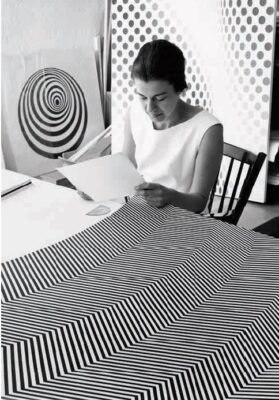
Bridget Riley, pictured here in 1964 at work in her Earls Court studio that she had decorated entirely in monochrome. (Copyright: Conde Nast Publications Ltd)
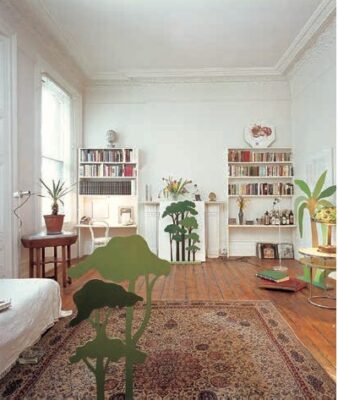
David Hockney made a variety of plywood trees to enliven his minimally furnished Notting Hill studio flat, pictured in 1969. (Copyright: Conde Nast Publications Ltd)
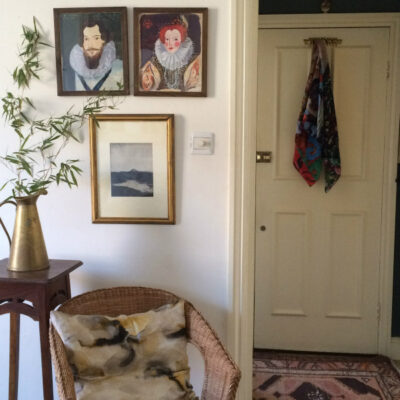
In Catriona’s studio: a pair of paintings by Michaela Gall for The Shop Floor Project hang above an Arts & Crafts jardinere and a wicker chair from Ikea. You can just catch a glimpse of the emerald-blue paint from Emerie & Cie which was used to paint the hallway.
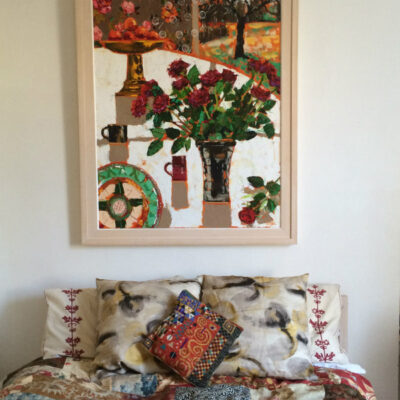
Above the bed hangs a painting by my mother. The cushions are in a Zoffany fabric, while the pillows behind were from John Rocha. The quilt was handmade from an assortment of textiles.
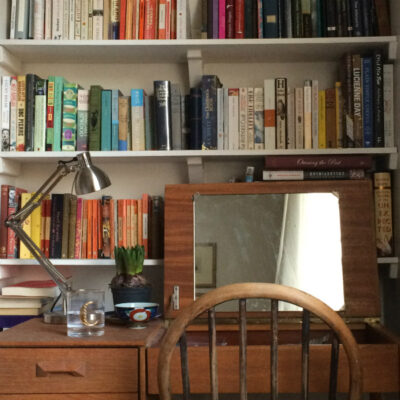
An old type tray contains my collection of odds and ends. I’ve got a magpie’s eye for old bits of broken china – as a child, I used to find them in the garden.
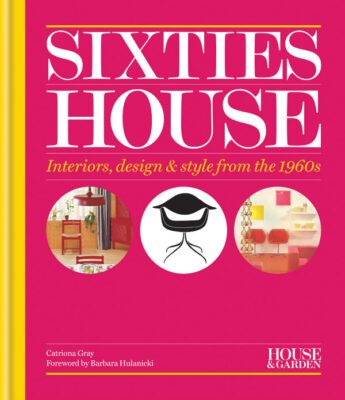
House & Garden Sixties House by Catriona Gray (Conran Octopus, £30) is out now. (www.octopusbooks.co.uk). Instagram: @cat.gray




The Cornershop Cookbook

In spite of our best intentions, we end up making supper out of ingredients hastily bought from our local cornershops more than we like to admit. This can mean tinned soup and cheese toasties or, alarmingly regularly, fish finger sandwiches. Sophie Missing and Caroline Craig understand this and have written The Cornershop Cookbook to cater exactly for these situations, offering up more inspired suggestions for meals that can be made from a Tuesday night trip to Costcutter. Instead of fish finger sandwiches, they suggest fish finger tacos made with tortillas, salad, a quick tomato salsa and guacamole. Somehow this is much more impressive, and even something you could offer to guests, especially alongside some of the other Mexican-inspired dishes they suggest. They also have some tasty recipes for those nights when you are quite tempted to order a takeaway but want to avoid the expense and quite frankly the regret that often accompanies that decision. Foremost amongst these is their recipe for peanut butter noodles made with peanut butter obviously, but also plenty of lime juice (if you can’t find limes, they suggest a splash of vinegar) and DIY garlic chilli oil which cuts through the rich clagginess of it all. In our fantasy world, of course we waft around farmer’s markets sourcing the perfect ingredients for delicious salads, roasts and stews. In reality, we often have to make do with whatever we can forage from Londis on the way back from work, and The Cornershop Cookbook understands that. Hallelujah!

RCA secret postcard sale

Who wouldn’t want to snap up a piece of art for a bargain £55 by Steve McQueen, Damon Albarn, Peter Blake, Jeremy Deller, Maggi Hambling, Thomas Heatherwick, David Bailey, James Dyson and many other artists, ceramicists, illustrators and designers? The only question, with the Stewarts Law RCA Secret show and sale, is can you tell who created each artwork as they are all exhibited anonymously? Almost 2,000 postcard-sized artworks will be up for sale at the show, now in its 22nd year, which will be open for viewing from 8th – 15th April, with the sale beginning on 10th April.  Guessing who has created which piece is hugely fun and you’ll only find out who the artist is after you’ve bought your postcard, with all profits generated from the sale going towards supporting emerging artists.  Buyers have to register first here and you can buy up to 4 postcards each.  Happy shopping!


Easter Treats

Still our first stop for delicious treats, Rococo has now added beautiful hand painted eggs to their Easter line-up. Milk chocolate honeycomb egg, £25

Daylesford’s sweet spiced shortbread chicks are adorable and gluten-free. £4.99

The chocolate chickens from Pump Street Bakery are made from single origin Madagascar Milk 59% and Grenada Dark 70%. £12


This Easter, Selfridges, Oxford Street is putting a typically bespoke spin on the ubiquitous Lindt bunny with an in-store personalisation service. £6.50 for the 200g or £20 for the 500g version.


Also at Selfridges the incredible Pierre Marcolini has outdone himself yet again with his beautiful Wonderland themed eggs and figures including this rabbit, £105.

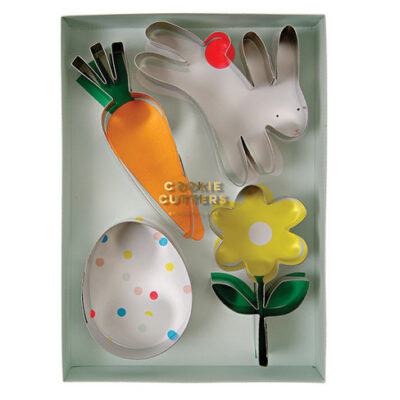
If you’re planning a party then do look at the accessories at Molly-Meg which include these adorable Easter cookie cutters, £9, from Meri Meri.


Personalised Jigsaws by Bloomfield & Rolfe

Our little one recently received a Bloomfield and Rolfe jigsaw puzzle for her sixth birthday, and she absolutely loves it. As do we. It’s a real keeper, and we’ll definitely order again for other children. The jigsaw, which has 30 pieces, is wooden and sturdy enough that it can stand upright after it’s been put together, rather than remaining stowed away in its box, and it comes with an identical card, which can be used as the picture guide. It’s one of those nice ideas that has been executed exceptionally well, with lots of attention to detail. There are five designs to choose from (and the message can say whatever you like as long as it’s less than 50 characters), including two that are Christmas themed. And while you are on the site, do check out Bloomfield & Rolfe’s other products – bespoke rubber stamps and cards and tags etc. They are all great, and make really good presents.

Isle of Roses Hair Oil

After the Isle of Roses hair oil was featured in British Vogue in September last year, a waiting list was set up for the product. This was before it was even stocked in the UK and it has only just hit our shores now. And we can see why it was such a hit; there’s a distinctly low-maintenance hippie vibe to dispensing a few drops of this light rose-scented oil into the palm of your hand and then rubbing over the tips of your hair and any other dry patches that might need it. It’s great for hair that is dry and prone to frizz, but if you have greasy locks you might want to exercise caution; it is always best to start off with little more than a drop anyway. It is by no means a cheap hair product at £42 for 30ml, but it will last you a long time. We particularly liked the fact it is one of the few styling products that can be used on dry hair, and because it doesn’t contain silicones, you can use it day after day and between hair washes without fear of build up. After using the oil, we were even tempted to toss our newly shiny, soft and subtly rose scented hair about a bit, and that’s not something we can say often.

Late March sample sales

Who: Cabbages & Roses
What: Big discounts on all clothing, samples, vintage pieces & fabrics
When: 18 – 19 March: 10am – 6.30pm
Where: 121 Sydney Street, SW3 6NR

Who: Bodyism
What: 50 – 70% off all activewear
When: 18 – 19 March: 2.30 – 6pm
Where: 222 – 224 Westbourne Grove, W11 2RH

Who: Stella McCartney
What: Big discounts on all womenswear clothing & accessories
When: 22 March: midday – 9pm; 23 March: 8am – 9pm
Where: 26 South Molton Lane, W1K 5AB

Who: Tod’s
What: Big discounts on all accessories
When: 29 March: 10am – 8pm; 30 & 31 March: 8am – 8pm
Where: 26 South Molton Lane, W1K 5AB

Who: Jenny Packham
What: End of line clearance with discounts of up to 80%
When: 23 March: 8am – 6pm
Where: Jenny Packham Showroom, 1st Floor, 34 North Row, W1K 6DQ

Bee Hive talk & dinner at Ham Yard Hotel

Some of the most unusual things in London happen right under our noses.  For example, did you know that Ham Yard Hotel, right in the centre of Soho, has a thriving set of bee hives and a resident Bee Keeper?  In celebration (and to raise funds for the bee hives), Ham Yard Hotel is hosting an exclusive event on it’s roof terrace.  Bee Keeper Camilla Goddard will give a talk, followed by honey and honey-based mead tasting from the Ham Yard bee hives.  Goddard will explain how different plants influence the flavour of honey and what to plant to encourage bees to your own garden or windowsill.  This will be followed by a delicious 3-course dinner at the Ham Yard Hotel restaurant.  Click  below to book your tickets.


The Saleroom – Auctions Online

We’ve always been avid fans of sourcing antiques and reclaimed bits and pieces on eBay but in the past few years it’s been hard to find a bargain; the site is awash with dealers and over-zealous sellers. Local salerooms are a far better place to get great deals but who has the time to traipse around the country to regional auction houses? This problem presumably inspired the brilliant – and highly addictive – The Saleroom. The site gathers auction houses from across Europe (and a few beyond too) and hosts live auctions. You can see catalogues and bid online once you have signed up. It brings a whole new world of antiques buying right to your laptop. Don’t forget most auction purchases are liable for a buyer’s premium and often VAT too – and you will need to collect your purchases too. But in the meantime, happy shopping!

It’s goodbye for now…

The team at A Little Bird are taking a break to recharge and make some exciting changes behind-the-scenes. We look forward to seeing you again soon.

CONTINUE TO SITE

A Little Bird Told Me…

SIGN UP TO OUR NEWSLETTER TO STAY IN-THE-NOW. ONLY LANDING IN YOUR INBOX ON THURSDAY MORNINGS AT 11AM.