The Vogue Blog, Mar 2011


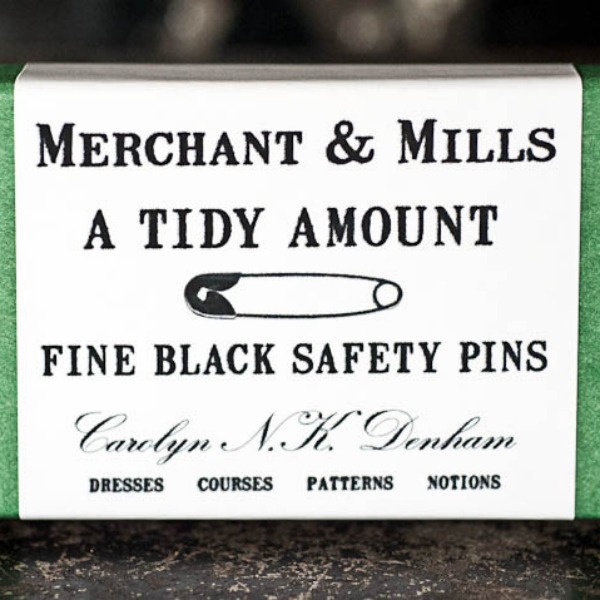
Whilst we would never claim sewing to be our strongest suit, we just adore the brilliant graphics and utilitarian design of this haberdashery shop. They sell fabrics, patterns and sewing essentials, most of which are British-made such as their Sheffield pinking scissors (from the same factory that supplies Saville Row) and oilskin kit bags, all of which you can buy straight from their shop in Hay-on-Wye, their website or stockists in London such as the Design Museum and Liberty’s. Above all, we love that the website comes with the warning, ‘Please be cautious when looking as many of these things are very hard not to want!’
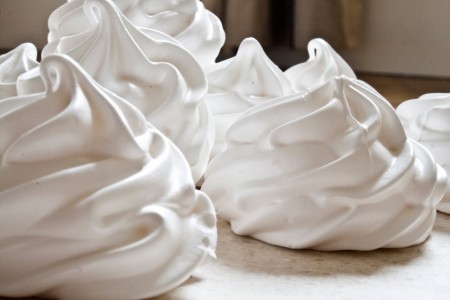
Whenever we make these meringues, we are asked for the recipe. People love them because they are crisp on the outside but mallowy inside.
There are two tricks to getting them like this: one is to weigh the egg whites, so as to get really accurate proportions. The other is to dissolve the sugar in the eggs whites before whisking. It’s the way the Italians do it, though this recipe comes by way of Baker & Spice’s book Exceptional Cakes by Dan Lepard and Richard Whittington.
Note: you really do need an electric whisk or mixer to make meringues this way, the heavier duty the better. You just couldn’t whisk thoroughly enough for the time required by hand.
Ingredients:
Egg whites and caster sugar.
Amounts? Here is how to get it right. Weigh the egg whites in grams, then multiply that weight by 1.95 (easy now that many phones have a calculator). The result is the weight of caster sugar you’ll need.
So if you use three medium sized eggs, you’ll probably have 115 grams of egg whites, and therefore need 225g caster sugar.
Technique:
Set your oven to 150°C / Gas 2 and cover a large baking tray, or two smaller ones, with non-stick baking parchment.
Put the egg whites and sugar in a scrupulously clean, grease-free, heat proof bowl over a pan of simmering water – just as you would to melt chocolate – and stir until the sugar has dissolved and the mixture feels just warm to the touch. Be careful not to actually cook the egg whites.
Put the mixture into an equally clean bowl of a electric mixer and beat using the whisk attachment for at least ten minutes—longer if you’re making many meringues and you’ve got a lot of mixture. The egg whites and sugar should be firm enough that you can turn the bowl upside down and nothing will fall out.
Now for the fun bit. Take spoonfuls of the meringue mix and make beautiful blobs of it on the baking tray. You can go as big or as small as you like. We like to go big.
Put the tray in the oven and immediately turn the heat down to 120°C/ Gas 1/2. Cook for 45 minutes – and perhaps a bit longer if you’ve sculpted really big meringues. You want them to be just set on the outside, though don’t pick them up till they are cool. The best way to finish drying them out once they have finished cooking is to turn the oven off, and leave them in there while it cools (obviously if you need your oven, just take them out and let them cool on their tray before transferring them to a tin or cake stand or whatever).

This is a real London treasure. It’s a toy museum and shop (a brill toy shop, too) housed in two adjoining houses in Fitzrovia, one 18th Century, the other 19th. It’s not that we’re dotty about toys per se, but Pollock’s is irresistible. You go up windy staircases and in and out of small interconnecting rooms and everywhere you look there are fantastically charming tableaux showing treasures, toy theatres, and every kind of teddy, toy, tin soldier and doll – some very old, some from far flung spots, all of them clearly treasured in their day. The way they are displayed and the accompanying information is really imaginative and touching. The whole place is so atmospheric and transporting that it makes you feel quite odd and dreamy (like you’ve entered many childhoods), but in a good way. This is a great place to take kids (of any age, but as it is for looking rather than playing, not so great for toddlers) on a rainy day, and you don’t need to book. Just show up, pay the entrance fee, and go through the small door on the right….

We are huge fans of Marianna Kennedy, a decorative artist and designer who makes beautiful tables and mirrors and lamps (and other things too as you will see from her website). You may know her Spitalfields house from the pages of World of Interiors (Feb 2011), but if you missed that, you can see glimpses of it on, again, the site. We want to live in her house. We’d also like to commission a painted green lacquer table with a bronze base, but alas we aren’t quite there yet. Instead, we have bought two of Kennedy’s signature resin lights (green ones with bright pink shades – heaven!), which we will treasure for ever and ever. Kennedy’s work is well known by those who know about interiors and furniture and lovely objects, but anyone can visit her studio on a Thursday (which is also Spitalfields market day), if they ring up and make an appointment – it’s a lovely thing to do. Kennedy will also be having a Paris show in the Autumn at the Galerie Chastel-Maréchal, but we’ll tell you more about that nearer the time. In the meantime, for a bit of anonymous and lustful cruising, do check out her website.
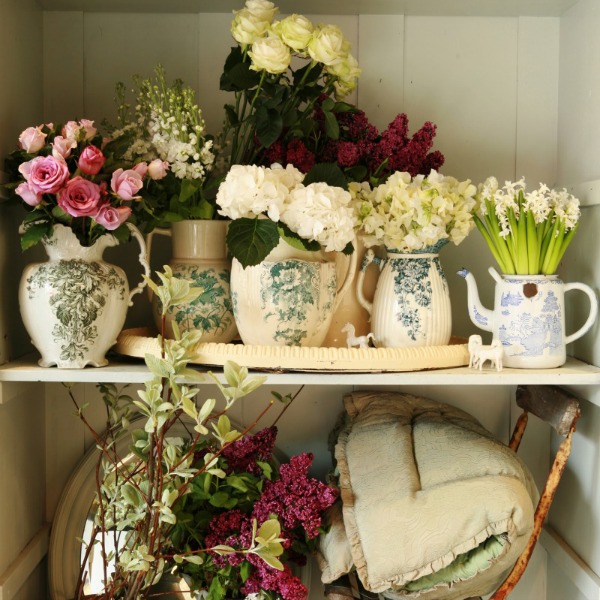
The dreaded Valentine’s Day is upon us. Why, when even if you 100% know for sure that nothing will be arriving through your letter box, is it still crushing when nothing does? Here is what we’d most like on or around Valentine’s Day. Flowers from Scarlet and Violet, please – our favourite ever florist. We thought we’d discovered them by stumbling across the shop in Queen’s Park years ago. Now it turns out Vogue are using them, so we can no longer claim them as a hidden find. They deliver all over London, are cheaper than some of the more centrally based florists, and all their arrangements are fantastic. Vic, who runs Scarlet and Violet has a fantastic eye and will do all kinds of events, grand or small, which is good to know. But finally, our favourite treat is their more informal posies which they deliver in oversized jam jars. Dare to dream.
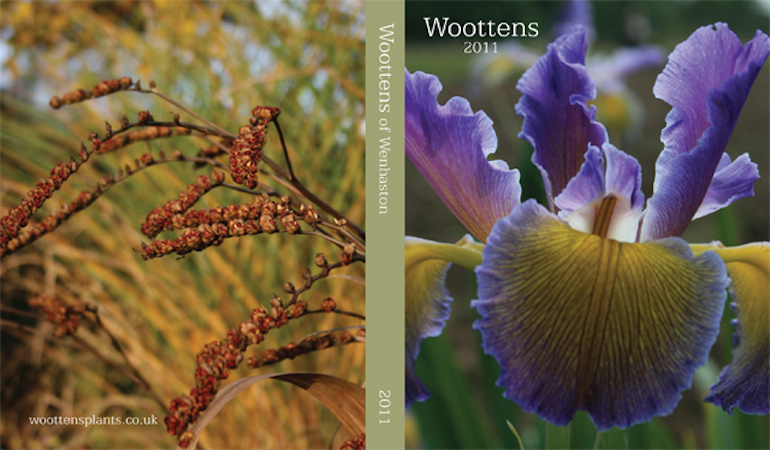
Woottens is famous in particular for its Auriculas, Hemerocalis, Pelargoniums and Iris (its two acre Bearded Iris field is open every year from 24 May to 10 June, and is worth travelling to see), but the nursery sells all manner of plants, always all faultless in our experience.
One of the reasons we love this nursery so much is the excellent information it supplies about its plants, via its website, over the phone, or in its handbook – except these last few years it was hard to get your hands on a copy of the latter, which was last published in 2007. (Word went round the gardening community that the exacting Michael Loftus, who runs the nursery, hadn’t found publishers who could deliver the quality he insisted on at an affordable price, so instead of compromising, he just didn’t do it). Copies of the 2007 edition became closely guarded and were lent out like contraband.
But now, four years later, Loftus has produced a new handbook. Its photographs are coffee table quality, but it’s the text that we especially love. Loftus gives just the right amount of history about plants, and plenty of expert, unpatronising advice on both growing and planting. His descriptions of the way plants look are wonderful – pithy, informative and tempting. We’ve ordered a copy for ourselves and several more to give away as presents. Wait till you see the photos of the Auriculas, just for starters. Beyond greed-inducing.

January isn’t the most inspiring month for fresh ingredients—except, that is, when forced rhubarb and Sicilian blood oranges make an appearance. There is no better way to use the latter than in a jelly. This is one of our most favourite recipes ever—it’s just an added bonus that it comes into its own in the depths of winter (though you can make it any time using ordinary oranges), when you need it most. Given to us by Rory O’Connell, genius chef and teacher at the Ballymaloe Cookery School, it is juicy, bright, sharp, sweet, tangy, zesty and totally delicious. The perfect pudding to counteract January blues.
Blood orange jelly with mint:
Serves 6 – 8 / fills a 500ml jelly mould
6-8 (depending on size) blood oranges (or any citrus fruit)
Juice of 1 lemon
170g granulated or caster sugar
1 teaspoon Grand Marnier (optional)
4 leaves of gelatin
2 tablespoons of chopped mint – for the sauce
First make a syrup by boiling 250ml water with the sugar for about two minutes until the sugar has dissolved.
Line either one large mould or 6-8 small round or oval moulds or 3-4 ramekins with cling film. Use enough so that the cling film drapes out over the sides of the mould.
Grate the rind from two of the oranges, being very careful not to include any white pith, which tastes bitter. Put this into a bowl with the juice of a lemon, the syrup you have made and the Grand Marnier (which you won’t taste, but heightens the other flavours).
Soak the gelatin leaves in a bowl of cold water (this needs at least ten minutes to soften).
Now segment all the oranges, including the ones whose skin you zested. Do this over the syrup bowl so that you catch any falling orange juice. This is the only fiddly part of the recipe. To segment an orange use a sharp, serrated knife. Cut off the top and bottom of the orange, so it can sit up without rolling over. Now, peel the orange with the knife, taking off all skin and pith, in a round, circular motion, so that in theory you get one long, curly piece of peel (as in the photo, below). Then cut out the individual segments out of this skinless orange and put them into your bowl, so that you get neat(ish), skinless, pithless pigs of pure orange flesh. Squeeze the orange ‘cores’ to get any remaining juice into the bowl with your syrup, orange segments, lemon juice etc.

Now strain the juice and syrup away from the orange segments, and measure 330ml of the liquid. Put the remaining liquid into a jug – this will be the juice that you will pour over the finished jelly.
Take out the now softened gelatin from the bowl of water and carefully try and squeeze out as much water as you can from it. Then put it into a small saucepan with a few splashes from your 330ml of liquid. Heat very gently, just so the gelatin dissolves into the liquid. Then return the juice and dissolved gelatin back to your liquid.
Fill your mould with the juice and segments of orange. Put in the fridge and allow at least 3 -4 hours to set. Overnight is best.
To make the sauce: simply add the chopped fresh mint to the left over jelly syrup/juice. If you don’t have much leftover liquid, you can top up the sauce by adding freshly squeezed orange juice and a little sugar to taste.

It’s one of Anya Hindmarch’s favourite shops and, if you like mid-century modern furniture, it is sure to become one of yours too. Set up in 2005, you can view their new stock online every week from designers such as Arne Jacobson and Charles and Ray Eames, and if you want to see the furniture yourself (along with their excellent vintage lighting), they have a 1000 sq ft shop in Crystal Palace. Even better, it’s all at mostly affordable prices.

A friend asked for a list of our favourite gardening books. We didn’t have to think for too long. The RHS Encyclopedias are great reference books, but she was after inspiration. Where to start? We sucked our teeth and began to email names like Alvide Lees-Milne and Rosemary Verey, but the book we actually ordered for her as a present is Garden People by Ursual Buchan. It’s ostensibly about the gardener and photographer Valerie Finnis. She was married to Sir David Scott, one of those English figures famous for his charm, whom all women found irresistible, even when he was about 108 years old. Together they knew, and Finnis photographed, everyone who ever gardened. The book is filled with Finnis’s photographs which are wonderful, as well as lots of great anecdotes about Finnis and Scott (within an hour of being married, they were out on their hands and knees weeding), and other great garden obsessives. We still look through this book with a notepad close by so that we can steal lots of plant and garden ideas.
Nancy Lancaster is on the cover. It’s worth getting the book just to see her outfits.

The end papers make you long to plant poppies. These are Papaver rhoeas ‘Fairy Wings’ photographed by Finnis.

And these are Papaver nudicaule ‘Constance Finnis’.

Here is Rhoda, Lady Birley in her garden at Charleston. How chic? And how about her borders. The book is filled with images and characters like this.

Finnis loved alpines and was particularly good at growing them. These, in 3 inch clay pots, include drabas, dionysias, campanulas and saxifrages.


Danish chef Christoffer Hruskova worked at a Michelin starred restaurant in his native land before opening his latest, greatest restaurant, North Road in Clerkenwell. The light wooden flooring and white walls serve as a fitting backdrop for a pared-down Scandinavian feel – there is no ‘jus’ or fussiness here to distract from the clarity of the delicious ingredients. Instead you’ll find slow-cooked leg of Gloucester old spot in hay, and raw, cured, hand dived Scottish scallops, followed by puddings such as forced Yorkshire rhubarb and beetroot. Lunch is good value at £20 for three courses, but we’d recommend the evenings for a little more romance.