As we’ve said before can’t get enough of Sarah Raven’s wonderful website which not only sells many of her favorite flowers as seeds, bulbs and plants, but also provides a brilliant source of instructional videos, usually filmed against the backdrop of her picturesque gardens at her farm, Perch Hill in East Sussex. Visiting the gardens – and nearby Sissinghurst where Raven used to live – and hearing the writer, broadcaster and cook talk is on our never-ending to do list. In the meantime though we are lapping up all the sage advice in her latest book, The Cutting Garden Journal which is largely based on the philosophy of her much lauded first book, The Cutting Garden, which was written 20 years ago. The Journal – as the name implies – is arranged around the gardening year and packed with advice on what to plant when, and how, as well as lots of tips on collecting your eventual harvest too. If, like us, you love having vast vases, urns and other receptacles full of glorious flowers, then this book will be incredibly useful. There are garden layouts for small as well as large spaces and sketches of Raven’s own schemes at Perch Hill too. Having a garden full of your own flowers is, as the writer says in her introduction, “the ever-filling cup, that never fails to deliver.”
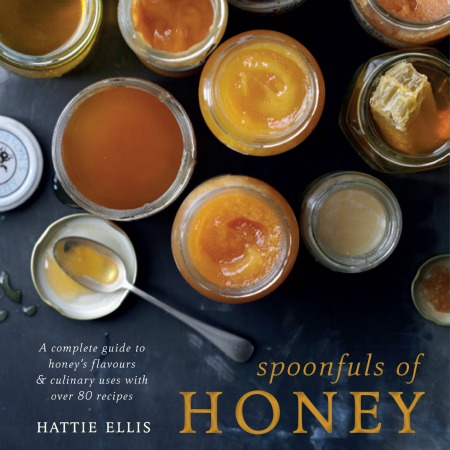
We loved Martha Kearney’s show The Wonder of Bees that was shown on BBC 4 earlier this year. The four part series followed a year of Kearney’s own bee-keeping adventures as well as demystifying the science and culture of these fascinating, ingenious creatures. It certainly made us rethink the brilliance of a jar of honey. So we were perhaps a bit more excited about a new honey-based cookbook than we may have been otherwise. Like Kearney’s show, Hattie Ellis’ Spoonfuls of Honey delves into the incredibly complex world of honey – from how it’s made to the myriad versions of honey from around the globe. But the bulk of this book is dedicated to recipes that include the more obvious uses (a scrumptious lemon and honey drizzle cake or a honey and fig frangipane tart) to more unusual ideas – adding honey and red wine to chorizo slice to create a delicious glossy glaze or honey roasted roots which entirely transforms a bowl of simple root veg into a brilliant side-dish – or, we found, a meal in itself. There’s nothing tricky here but plenty of great ideas to take away – and to revive a love of honey.
If we were left to our own devices and didn’t have to cater to anyone but ourselves, we could quite happily subsist on salads day in, day out. Not the limp lettuce bought in plastic pots, of course, but big bowls filled with leaves, pulses, nuts, vegetables, fruit and anything else handy in myriad combinations. So we were particularly pleased to get a copy of Salmagundi; Salads From The Middle East And Beyond – the third book from Sally Butcher, who runs Peckham’s Persian cornershop Persepolis. Salmagundi is actually a seventeenth century English word that describes a salad with many component parts – a sort of Jacobean Cobb salad perhaps. And there are salads here from around the world – far beyond the Levant that the title implies. Yes there are plenty of moreish Middle Eastern treats here from Turkey, Iran, Iraq, Egypt and so on, but Butcher scours the globe from Cambodia to California and everywhere in between bringing together the ultimate, unadulterated versions of classics alongside more exotic combinations too, such as the unctuous and utterly delicious Warm Aubergine with Garlic Yogurt and Caramelised Walnuts. This book is a great compendium of ideas for salad addicts but it’s really a very entertaining read too. Butcher is funny and incredibly inquisitive so the pages are littered with either helpful or humourous asides. And while nothing in this book feels like a diet-type salad, the very concept of dishes that for the most part utilise grains, vegetables and leaves means that you could easily use this book as inspiration for a carb-free diet. Not that you’d feel deprived for one second.
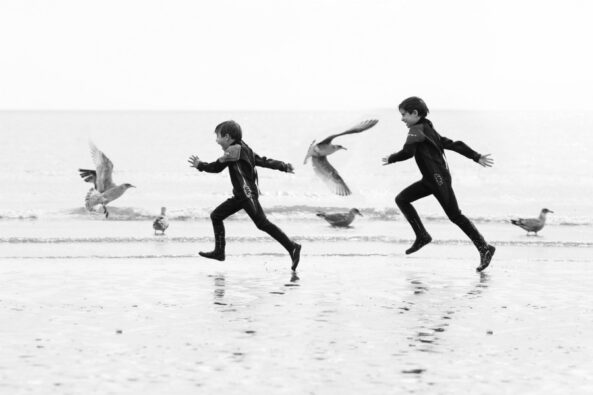
As I write this post summer is well and truly here, the kids are off school and the next few weeks stretch out before us with thoughts of days spent playing at the park, building sand-castles on the beach and eating enormous quantities of ice cream. It’s lovely to have a record of these fun-filled days that you and your children can look back on. You don’t need a top of the range camera to get great results – even camera phones can produce incredible results when used well. The best camera is the one you have with you.
Top Tip No 1. Keep it Fun
In the years I’ve been photographing families I’ve found that the key to capturing successful photographs of kids is for it to be fun. So being prepared with the camera whilst your children are playing is perfect – they’re unaware of what you’re up to!
Top Tip No 2. Light Makes The Difference
Practice beforehand to make sure you know how to adjust the exposure on your phone – situations like the beach, where there are large, light areas in a picture, can confuse the camera’s light meter. The great thing about camera phones is you can see straight away if you have got it right, and you can always take another if the exposure is awry. I recommend looking for shade where you can, as this produces beautiful light. If your children are playing together in direct sunlight, move them under a tree – they will continue their game within seconds, forgetting you have moved them and you will have lovely, soft, flattering light to work with. If you would like to take a group photo of your children, sitting them in the shade of a tree looking out towards the sunlight will give you lovely soft light on their faces and beautiful catch-lights in their eyes. Do watch out for mottled light, though, as this can create contrast problems with areas of your picture bleached out.
Top Tip No 3. Get Up High…Or Low
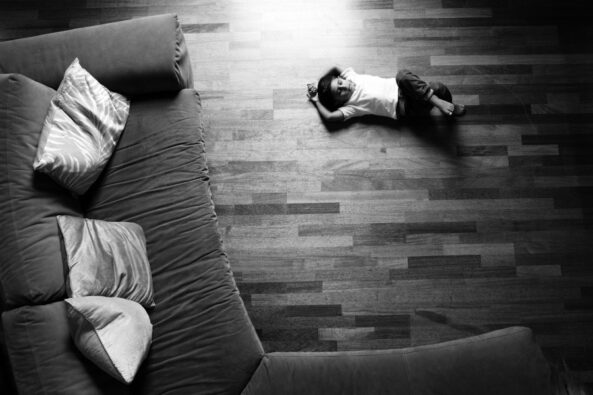
When photographing children, I try to get down to their eye level and sitting on the floor playing with the kids and taking pictures as you chat works really well for this. You can also look for interesting angles – for example, a photograph of the children playing football in the garden taken from an upstairs window will give you an interesting perspective on a daily activity.
Top Tip No 4. What’s In The Shot?
When composing your pictures, try to think about all the different elements that will end up in the photo. If you are planning a simple portrait, fill the frame with your subject so that distracting elements in the background are minimised. Or, think about using the surrounding environment for a really lovely photograph that has an element of story telling; a child sitting on their bed could be a close-up portrait lit by a window, or an environmental portrait showing your child’s room with their favorite toys, posters on the wall and all the details that make them who they are at this time. These elements change so much as children grow and it’s amazing how much a picture of a much-loved toy or favourite duvet cover will transport you back in years to come.
Top Tip No 5. Timing Is Everything
The time of day will make a big difference to your pictures, too. As photographers, we talk of ‘the magic hour’ at sunrise and sunset when there is an amazing quality of light, but when working with children, practicalities take over. In my experience, the hour just before sunset is time best spent with the children well-fed, bathed and snuggled up with a story before a good night’s sleep, rather than running around having their portraits taken – certainly if you want co-operation from your subjects. I find that first thing in the morning, straight after breakfast, is the ideal time if you want your children to pose for you – everyone is full of energy, full of toast, and ready to take on the day. This is a great moment for an impromptu photo shoot and if you are in the park early, you can be sure you will have the pick of all the best spots before anyone else arrives.
Top Tip No 6. Be Silly
When taking group shots of your children, I suggest trying to make them laugh but don’t ask them to smile; goofing about, singing silly songs and, if you are lucky enough to have someone else around, then getting them to leap around behind you is a surefire way to capture wonderful expressions.
Top Tip No 7. Don’t Forget About You
Also, make sure that you’re in some of the photographs yourself, particularly if you are the parent who is always behind the camera – either ask a friend to take some of you, use a self timer, or even hire a professional. These pictures, which include parents and loved ones, are those your children will treasure most as they grow up.
Top Tip No 8. Lastly, Have Fun
Most of all, make sure that you have fun and do the activities that your children enjoy – a laughing child on a swing, a look of joy as they are sprayed by a hose, or a quiet moment with book will always make a great photograph, and the natural moments that capture your child’s personality will touch your heart. Photographs are a precious thing to have and a joy to take; I hope these tips will encourage you to get out and about with your camera (or phone) this summer.
We’ve long cherished childhood summers spent on the Dorset coast so couldn’t wait to book in at The Pig – on the Beach, The Pig hotel’s latest outpost in Studland Bay, which opened last month. Crossing on the chain-ferry from Poole to the Isle of Purbeck brought back all the fervoured impatience of our youth. Some of the UK’s finest sand beaches and dunes are here, and The Pig – on the Beach knows it has a plum position from which to enjoy them. It’s an incredible, eccentrically turreted coastal villa, flanked by two thatched cottages – The Bothy and The Hideaway – like something out of The Hobbit.
We took our own little piglets who squealed with delight at the bronze floppy-eared pig manning the entrance, then at the chic little buckets and spades awaiting them in their room and again, intermittently throughout our stay – the wildflower meadow elicited yelps of ‘swishy swashy grass, mummy!’ And deservedly so, for it is truly charming. The honeyed exterior and lavender beds give the place an almost Provencal glow, and the whole place seems to bubble effortlessly – a sure sign of its unflappable team.
The hotel actually bills itself as a restaurant with rooms and is right to boast of its abundant kitchen garden (peas, courgettes, fennel) and local-sourcing (everything else comes from a 25 mile radius). We could write odes to the Isle of Wight tomatoes. At breakfast, our table ached with homemade granola, muffins, rhubarb compote, light-as air patisseries and eggs from the resident hens. We ate like Trojans. And afterwards, snacked like piggies from the room’s larder (sherbert!).
Had we wanted to be true sybarites we would have booked in for a pummelling at one of the two Shepherd Huts, where treatments use Bamford products. Instead we retreated to our triple aspect room with its long billowing drapes, driftwood-style floorboards and Roberts radio (set to Classic FM) to contemplate our sheer luck – taking two kids under three anywhere and feeling spoilt is a slice of heaven. And having spied the log-fires, we can’t wait to come back in winter.
Now by Robert Browning is the perfect sonnet for proposals and declarations: urgent, imploring, and passionate, this is love poetry at its super-charged, swoon-inducing best.
Now by Robert Browning (1812-89)
Out of your whole life give but one moment!
All of your life that has gone before,
All to come after it, – so you ignore,
So you make perfect the present, – condense,
In a rapture of rage, for perfection’s endowment,
Thought and feeling and soul and sense –
Merged in a moment which gives me at last
You around me for once, you beneath me, above me –
Me – sure that despite of time future, time past, –
This tick of our life-time’s one moment you love me!
How long such suspension may linger? Ah, Sweet –
The moment eternal – just that and no more –
When ecstasy’s utmost we clutch at the core
While cheeks burn, arms open, eyes shut and lips meet!
I love the wry humour in Modern Declaration, and the realism, and the way she lifts the veil of cynicism to reveal the truth of her feeling.
Modern Declaration by Edna St Vincent Millay (1892-1950)
I, having loved ever since I was a child a few things, never having
wavered
In these affections; never through shyness in the houses of the rich
or in the presence of clergymen having denied these loves;
Never when worked upon by cynics like chiropractors having
grunted or clicked a vertebra to the discredit of these loves;
Never when anxious to land a job having diminished them by a
conniving smile; or when befuddled by drink
Jeered at them through heartache or lazily fondled the fingers of
their alert enemies; declare
That I shall love you always.
No matter what party is in power;
No matter what temporarily expedient combination of allied
interests wins the war;
Shall love you always.
I Would Live in Your Love is short but sweet, with a striking metaphor for the accommodations and togetherness of married life.
I Would Live in Your Love by Sara Teasdale (1844-1933)
I would live in your love as the sea-grasses live in the sea,
Borne up by each wave as it passes, drawn down by each wave that recedes;
I would empty my soul of the dreams that have gathered in me,
I would beat with your heart as it beats, I would follow your
soul as it leads.
We’ve been having rather a fun time of late at independent gourmet merchants that double up as restaurants. Following a sumptuous eve at butchers Hill & Szrok a few weeks ago, we ventured west from Broadway Market to the nattily named Prawn on the Lawn, near Highbury Fields.
Set up by Rick Toogood, who earned his scales at Fishworks, the bijou space is fishmongers by day, restaurant by noon and night (lunch and dinner, that is). Crustaceans and south coast catches of the day lie on ice in the window, illuminated by lights hanging in fisherman’s lanterns. The inviting street scene sets the ambience for inside, which may be small, but employs innovative design quirks to make the most of the cosy space (much like the inside of a boat, aptly). Diners gather around upturned barrels and along the raised wooden bars that line the exposed-brick and white-tiled walls, above which are elegant iron rails, from where various of the courses are served in hanging bird trays or scales. Overhead, lights shine from within woven lobster pots; in the back, but touchably close, the kitchen team furiously chops, shucks and dices. It’s seductively snug, with space for 35 covers.
The chalked blackboard menu changes daily, but we started with three wildly different oysters – briny, small and perky Jersey Rocks; longer, creamier Carlingfords from Ireland and our favourite, the pink, meaty wild Black Waters form the Essex coast. Washed down, of course, with fizz: a delicious, almost appley sparkling Albarino (hard to find in London, we were told).
The eponymous Prawn on the Lawn was next – a luxurious and generous smashing of mustard-seedy avocado on homemade soda bread topped with prawns and chilli that was gloriously fresh. Following swiftly were three spears each of cold and crisp asparagus with the lightest of crabmeats and crème fraiche: zingy and moreish.
Robustness came from potted mackerel pate with tiny beetroot cubes, spring onion, garlic, crème fraiche and a kick of horseradish, served with sweet yet tart gooseberry chutney that cut through the meaty intensity. Seared tuna slices were brought to life with chilli and lime in an Asian twist on proceedings, while jumbo prawns, served on the half shell came Thai style with ginger and carrot, and a crisp, tropical glass of Fasto Verdejo. Yum.
Each course was but a few mouthfuls, so there was ample room for two puddings – thank heavens as they were sublime: a cooled salted caramel pot that was a gooey mass of toffee deliciousness, served with strawberries; and an affogato drizzled with sweet, heady sherry and little amaretti biscuits.
We’ll definitely be going back, but next time, we might just take them up on their offer (as highlighted in the window): “bring your own dish for an oven-ready fish”.
The Pump Street Bakery is one of our favourite places in Suffolk – a wonderful bread shop and beautifully designed café in the idyllic village of Orford. Although really it is more than that, as it has another outpost a few miles away in Snape Maltings, as well as Cedric the Citroen van that travels to different villages and towns delivering loaves and exquisite pastries. But not content with creating the most delicious bread in the county (owner Chris Brennan worked for IBM before retiring and then commencing his baking odyssey), the bakery is now building up quite a formidable reputation for its chocolate too. The latest is a Sourdough and Sea Salt bar – a 66% Venezuelan chocolate spiked with crunchy sourdough breadcrumbs and sea salt. Now if it doesn’t strike you as the most harmonious combination then just consider the perfect marriage between a dollop of pretty much any decent chocolate spread, slathered over a hunky of fresh crusty bread. Exactly – it’s genius. And better still, you don’t need to trek to Suffolk to buy it – the chocolate (and the bakery’s bread) is available to buy from their online shop and there are lots of local London stockists too, from Fortnum & Mason to Clerkenwell’s Quality Chop Shop.
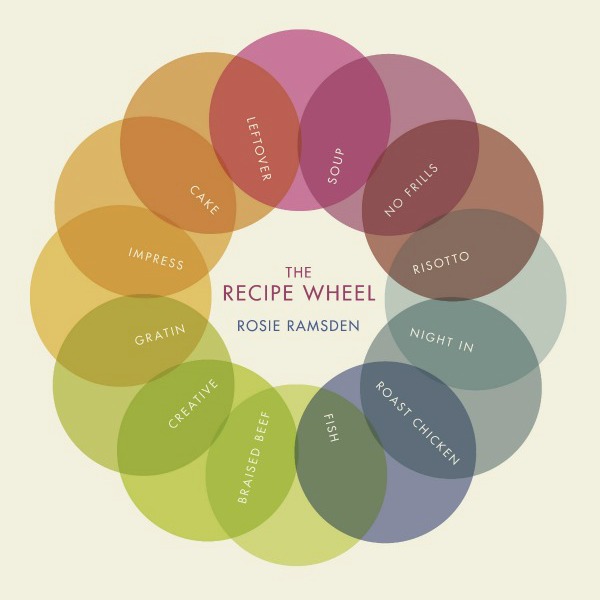
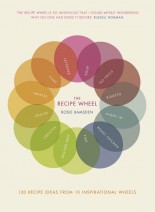
What’s quite clever about Rosie Ramsden’s debut cookbook is that really – beyond the jazzy rainbow coloured wheels and charts – it’s really about the way most of us cook. The Recipe Wheel takes a classic dish – for example a basic risotto – and then after running through the core recipe, expands on it with off-shoots (this is where the wheel comes into play) which encompass most of the scenarios that you would cook for – no frills, a night in, recipes to impress or ones to use up leftovers. So that basic white risotto gets tarted up into a fresh spring broad bean, parmesan and mint risotto or into another variation using a more summery mix of fennel, artichoke hearts and ricotta. While the leftovers are recycled into seriously moreish deep fried risotto balls.
Each chapter kicks off with one of these core recipes – braised beef, poached fish, potato gratin, custard, sponge cake, roast chicken – they are all very simple and straight-forward staples but it’s the spin-off ideas that will most likely inspire you to diversify; adding cherry tomatoes and crushed potatoes to your roasted chicken for an unctuous supper or creating a pot roast with your chicken by throwing cannellini beans and chorizo into the mix and a dollop of romesco sauce to finish.
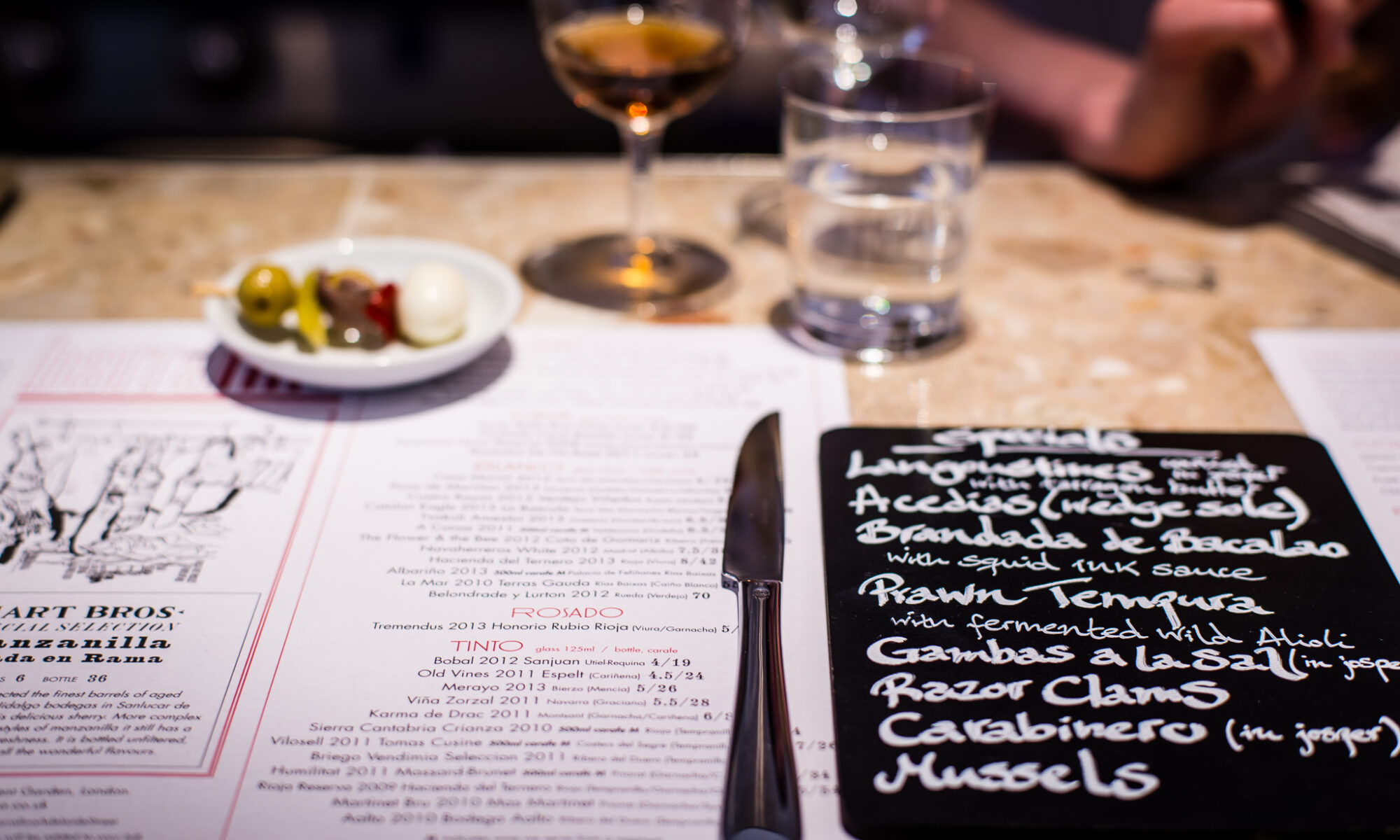
We’ve long been fans of Barrafina, the delicious Spanish tapas restaurant in Soho owned by Sam and Eddie Hart, two of the most charming guys in the business (also owners of Fino and Quo Vadis). Our only quibble is that on popular nights, with their no-reservation policy the queue can get a little long. So it’s great news then that they finally found another site and on Monday, opened their second branch. With wrap-around windows and high ceilings looking out onto Adelaide Street just around the corner from The National Portrait Gallery and St Martin’s Lane, there is the same mix of classic and contemporary tapas on offer along with some new dishes such as carpaccio of Mediterranean prawns with bonito. There’s a private dining room too (for up to 60 people) and whilst it also has a no reservations policy, you can order drinks and order smaller tapas whilst you wait for your seat.
Three of my favourite restaurants are along one street in the old town of St Tropez; this was the area that Brigitte Bardot described as the most romantic part of the town. On rue des Remparts you will find La Ponche (5 rue des Remparts, 83990 St Tropez), Le Mazagran and La Pesquiere (both 1 rue des Remparts, 83990 St Tropez). They are all great but Pesquiere is probably my favourite – it has a beautiful view over a little beach and we have had some amazing big family dinners, as you can reserve the long tables here. Kids can run around and it’s always fun. The aubergine aux tomates is really nice with lots of garlic and I love both the calamari and the ratatouille – simple but just delicious.
A little bit further up the rue des Remparts – although you will be able to smell it long before you get there – is the amazing Grand Marnier crêperie. Once you have eaten these you won’t want to eat crêpes anywhere else – they are very, very thin and crispy but really rich and buttery too. It’s been here for years and the guys that run it wear these amazingly tall chef’s hats. The grand marnier and chocolate crêpe is perfect to have after dinner. If you ask nicely they will sometimes let you go behind and try to make one yourself.
Club 55 is probably the best-known beach café on Pampelonne beach – in the summer they will serve up to 900 people a day. But away from the busy side of town there’s Les Graniers (Chemin des Graniers, 83990 St Tropez) which is a bit more secret and a wonderful place to go for lunch. They do very simple but delicious things like buttery corn on the cob. You can also go on little beach walks along the coast from here too.
There are so many lovely little villages around St Tropez that are also worth visiting and if you’re into food L’Auberge de la Môle (Place de l’Église, 83310 La Môle) is such an amazing experience. It’s a really beaten down place about 20 minutes from St Tropez – it’s not flashy at all and it’s not expensive. Inside is very cute with a beautiful kitchen that does an phenomenal seven course menu, starting with a plate of fabulous home-made pates. Everything is made on the premises and the food is very local. It’s such an experience although, you certainly couldn’t go there every day.
I definitely recommend getting a bike and doing a cycling tour of the towns around St Tropez, which I do with my dad all the time. You can go up to the castle in Port Grimaud and see all of the bay from there. La Table du Mareyeur (10 & 11 Place des Artisans
83310 Port Grimaud) is another favourite place to go – it sits right by the water, next to one of the village’s little bridges. You can moor right behind the restaurant too if you’re travelling by boat.
When he was 18 years old Dennis Hopper started taking photos. Between 1961 and 1967, at his most prolific, he took 18, 000 pictures but stopped taking them altogether when he was 31 – the same year that he wrote and directed Easy Rider. And in many ways much of the work in Dennis Hopper: The Lost Album feels like the ultimate research project for his directorial debut.
We may know him as an iconic counter-cultural actor, but Hopper was also a painter and sculptor as well as photographer and he moved seamlessly between mediums – and worlds. His photographic subjects – Hollywood actors, rock stars, bands, artists (on both the West and East coasts), hippies and bikers – were also often his friends too. Hopper was at the epicentre of a world in the midst of the most dramatic shifts – sexual and social, political and cultural and his photos are an amazing personal diary of a time when he says the world “was on fire.” And in this show it’s all too clear how vital his creative outlets were – as a quote from Hopper says near the start of the show: “I never made a cent from these photos. They cost me money but they kept me alive.”
The 400 vintage prints that make up the Royal Academy show were selected and boxed up by Hopper and then discovered after his death in 2010. So not only has the show been to some extent curated by Hopper, but the Academy has also strived to show the prints exactly as Hopper displayed them with no frames and very simply mounted onto card. The only additions for this show are the glass vitrines that surround them. Most are small scale prints which forces you to get up close to see each picture. So you will definitely want to try and see this show without too many crowds – which will be tricky as it’s bound to be a hugely popular. But it’s also one not to miss.
It’s goodbye for now…
The team at A Little Bird are taking a break to recharge and make some exciting changes behind-the-scenes. We look forward to seeing you again soon.