The New Craftsmen

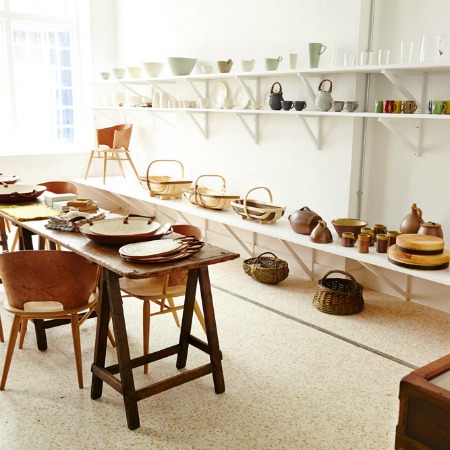
We are currently in the grip of making mania – home-spun knits and hand-thrown pots, traditional weaves and locally sourced crafts. And now there is a shop where it is all beautifully gathered together and displayed in a contemporary way. The New Craftsmen, originally a Mayfair pop up shop, is now a permanent store in a stunning arts and crafts building (once a workshop for makers of leather breeches) tucked away behind the throngs of Oxford Street. But inside could not be further away from that stretch of bustling, slightly depressing mass consumption. Here the calm, airy space is dotted with the most exquisitely crafted, hand-picked pieces from glassware and ceramics to books and textiles drawn from 75 makers from across the country and the idea is to not only showcase them but to provide the opportunity to commission bespoke pieces too.

There are many, many covetable things – Cornelia O’Donovan’s gorgeous hand-painted and embroidered cushions, Ernest Wright and Sons scissors made in Sheffield, Bespoke and Bound’s hand-made albums and books and Michael Ruh’s colourful hand-blown glass jugs. Needless to say none of it comes cheap – especially really special pieces like Pedro da Costa Felgueiras’s stunning chairs which we can only dream of owning. But then these are true luxuries – made slowly, thoughtfully and to last a lifetime.

A Modern Way to Eat by Anna Jones

Anna Jones is one of those foodie insiders who other chefs and cookbook writers have known about (and relied upon) for years. (She worked for Jamie Oliver for seven years as his food stylist, writer and food creative, as well as for lots of other chefs and food writers). A Modern Way to Eat is her book, though. It’s her recipes, written in her voice and it definitely heralds a new star onto the blocks. Jones is vegetarian (though hasn’t always been) and so obviously this is a book filled with vegetarian recipes. But that’s one of the reasons we love it so much, even though we are meat-eaters ourselves. It’s just full of delicious looking things that are straightforward to cook and have the added bonus of giving you lots of energy and making you feel great. Jones isn’t on a health mission as such, but is inspired – as we should all be – by Michael Pollen’s perfect dictum: ‘eat food, not too much, mostly plants’. She also realised that vegetarian cooking was missing a bit of a trick, either being too much of a substitution for meat (all that stodgy, cheesy stuff) or too nutrition obsessed (all that green juice). What Jones’ cares about most is flavour.  She is particularly good on texture (she uses seeds and nuts in really unexpected ways and combos), as well as on finishing touches – those things which can elevate a dish so much: a slick of yoghurt say, or a drizzle of herbed oil. All these things are evident in the recipe below, which we cooked the other night and loved and which works throughout the year with different seasonal veg. But because Jones isn’t interested in is denial, there are also good chapters on cakes, puddings and bread, including a stand-out recipe for salted caramel brownies (beyond). We love this book – its approach to food and eating, its recipes, and the original way it encourages you to go off piste – to which end Jones has included helpful charts in the book, which teach you how to build your own salad, cook roots and grains or use under-dog veg such as turnips and swedes in all kinds of tasty ways.


Sweet and salty tahini crunch greens

This is a recipe that changes as the seasons roll by. I like to have a plate of  greens on the table most evenings. Ordinarily they are quickly blanched and simply dressed with lemon zest, olive oil, salt and pepper. Here, spritely greens are bright, sweet and salty, nuts and seeds bring layers of favour and crunch, while the dressing is a happy blend of deep earthy tahini, zippy lemon and warm woody maple sweetness. This is a dish that delivers on every level. I often make a double batch of the seeds and keep some for snacking on throughout the day, they are so good. Below I’ve suggested greens to use through the year, but feel free to freestyle. I like to keep my greens vivid green with a bit of crunch – to me, cooking them for longer than a minute spoils their character. This way fewer of the nutrients seep into the water too. Follow the timings given below for different greens.

For the greens

  • 4 tablespoons pumpkin seeds
    4 tablespoons pistachio nuts
    1 tablespoon maple syrup
    sea salt and freshly ground
    black pepper
    500g mixed seasonal green veg (see list below)

For the tahini dressing

  • 2 tablespoons tahini
    juice of 1 lemon
    2 teaspoons maple syrup
    1 tablespoon extra virgin olive oil

Seasonal options

  • Winter · purple sprouting broccoli (40 seconds) and kale (30 seconds)
    Spring · purple sprouting broccoli (40 seconds) and asparagus (60 seconds)
    Summer · green beans (40 seconds) and broccoli (40 seconds)
    Autumn · shredded sprouts (30 seconds) and winter greens (30 seconds)

Preheat the oven to 200°C/fan 180°C/gas 6.

Put the seeds and nuts on a baking tray, pour over the maple syrup and season with a good pinch of salt and pepper. Toss so that everything is coated in the syrup, then roast in the oven for 10 minutes. Take out of the oven and allow to cool a little. While the seeds and nuts are roasting, make your dressing by mixing all the ingredients together in a little bowl or jug with a good pinch of salt and pepper. Next, blanch your greens in a big pot of boiling water. See the timings below for each one. Once your greens are blanched, drain them and place in a serving bowl or on a platter. Pour over the dressing and toss everything to coat, then top with the roasted seeds and nuts and serve straight away.

FISCHER’S (the latest restaurant from the owners of the Wolseley)

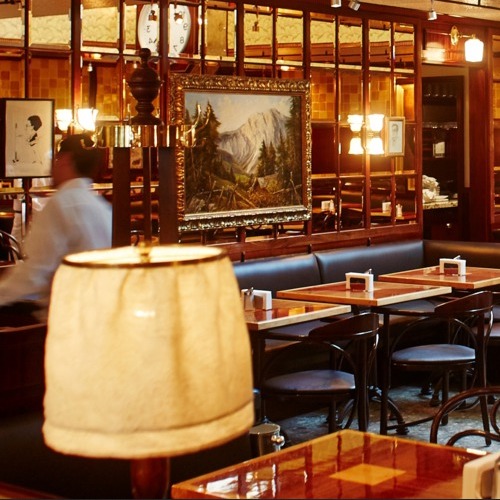
There’s always been a bit of a Germanic feeling at Chris Corbin and Jeremy King’s restaurants (from The Wolseley’s ever popular Bircher muesli to The Delaunay’s man-sized line up of Wieners & Schnitzels) but now the duo in their latest project, Fischer’s, have embraced the Viennese mood to the letter, so much so that you will probably feel as though you really have stumbled upon an old family-run fin de siècle café rather than the latest addition to Marylebone High Street. From the sumptuous leather banquettes and bentwood chairs and the glossy wood-panelled walls that are lined with old portraits or photographs to the old-style Fischer’s clock that hangs in an imposing position in the middle of the dining room, everything here contrives to make the space feel like it’s been here forever – rather than the week or so that it’s actually been open.

And although there are a few of the favourite dishes from the duo’s sister restaurants, the menu here is a proper tribute to the hearty, meaty dishes of Austria with an extensive Schnitzel and Wurstchen menu as well as mini Brotchen for teatime (little ryebread open sandwiches) and a scrumptious line-up of sweet treats including strudels and rich cakes like Sachertorte or Esterhazy Schnitten – a delicious layered meringue and cream cake. We have to admit that it can feel a little heavy on a midsummer’s day. But we suspect that it will come into its own in the winter – and we can’t wait to try the Schololadengenuss – a grand cru kalinga chocolate served with a jug of hot milk. It almost makes us yearn for autumn.

Sunuva

If you have small children then Sunuva – the UV beachwear specialist – is probably a brand already on your radar. The label was founded by friends Emily Cohen and Sabrina Naggar, when both parents found it impossible to find beautifully designed but UV-protective beachwear for their kids. Their collections are always colourful without being garish, with vibrant prints and lovely details (pretty dresses for girls come in boho tie-dye or gorgeous folk embroideries) but there are plenty of classic Breton stripes and graphic prints too. And they have pretty much everything you could want for summer hols from float suits and swim shorts to sweet playsuits.

Nina St Tropez

It’s more than likely that a savvy TV producer has already got their eye on Nina Parker. The chef’s just-published debut, Nina St Tropez, is not only packed with the most lip-smackingly delicious recipes, inspired by the Provençal town in which she has spent every summer since she was born; it’s also a luscious telly series waiting to happen.

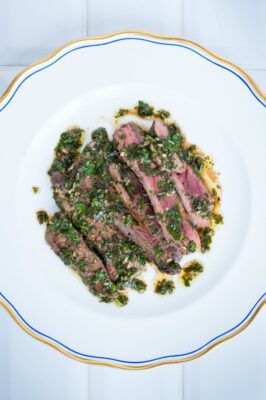
In her very personal cookbook, lovely pictures of cafés and restaurants, beaches and coves, sit side by side with equally picturesque photos of Parker, often in denim shorts and a golden tan, browsing markets, catching fish, whipping up towering pavlovas crammed with summer fruits and Marsala cream. It all makes you wish that you were Nina – or, at the very least, that you could hop on a flight to Nice pronto. But the best thing about this book is that you’ll just want to cook it all. The fabulously aromatic Bun Man Chicken would convert even the most strident roast chicken purist; the moreish steak with Parker’s piquant version of a salsa verde is just so good. And even better, it turns out, crammed into a crusty warm baguette the next day. There are lots of local classics – pissaladiere, salade Niçoise, soupe au pistou – as well as a section devoted to tarts and pizzas and salads and snacks perfect for a beachy picnic. And there are so many more things we want to try out – the slow cooked pork shoulder with peach, the butternut squash roasted with fennel seeds, not to mention every single one of her gorgeous, glossy rich cakes. It’s a love letter to the south of France as much as anything; as Parker, who has worked at Locanda Locatelli and Bocca di Lupo before setting up her own catering firm, says in her introduction: “This is not the new St Tropez, it’s the real St Tropez.”


STEAK À LA NINA

I once worked as a waitress at a restaurant called Le Relais de Venise, or L’Entrecôte, and I was immediately drawn to its menu, The Formula: a simple walnut salad with mustard dressing followed by steak and chips smothered in a sauce with 26 different ingredients. The sauce has stuck with me since I was 18, and after trying – unsuccessfully – to prise the secret ingredients out of one of the chefs, I have devised my own, less complicated recipe. Chips are probably this dish’s best friend, but to keep it light you could serve it with grilled or roasted vegetables.


SERVES 6

2 rump steaks, about 200g each

2 tbsp groundnut oil

1/2 tsp sea salt

black pepper


FOR THE SAUCE

1 anchovy fillet, chopped

60ml olive oil

bunch fresh tarragon leaves

(about 50g), finely chopped

handful fresh flat-leaf parsley,

finely chopped

juice of 1/2 lemon

1/2 tsp sugar

1 tbsp Muscat vinegar or white

wine vinegar

20g unsalted butter

1 large clove garlic, diced

sea salt and black pepper

Remove the steaks from the fridge to allow them to come to room temperature. First, make the sauce. Put the anchovy in a bowl with all the olive oil except 1 tablespoon. Add the herbs, lemon juice, sugar and vinegar. Heat the remaining olive oil and butter in a large saucepan until melted and hot.

Add the garlic and cook for a moment before adding it to the bowl, stirring everything together and seasoning with salt and pepper. Cover and set aside to keep warm. Wipe out the frying pan, place it over a high heat and add half of the groundnut oil. Season the steaks generously with salt, pepper and groundnut oil. Make a few slices into the fat

of each steak – this will help render the fat while frying. Once the pan is hot, use tongs to put the meat in the pan and cook for 2 minutes for rare, before turning over and cooking for 1 minute. Quickly brown the sides, then remove and set aside to rest in a warm place for at least 10 minutes.

Pour all the meat juices that have seeped out from the meat into the sauce bowl and use a sharp knife to slice the steaks. Heat the sauce in the frying pan. Mix the meat slices in with the sauce and serve with a pinch of salt sprinkled over.

Paul Winch-Furness


© Nina St Tropez by Nina Parker (Weidenfeld & Nicolson)

Cooking For Kids by Alain Ducasse

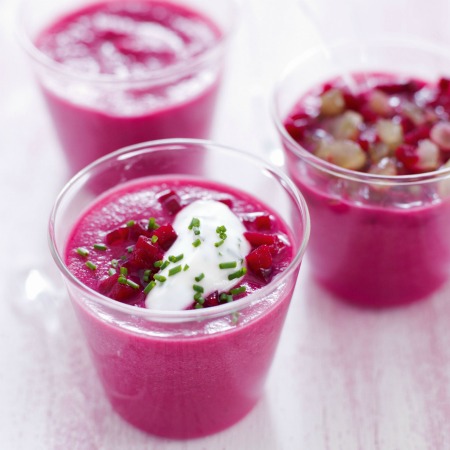
Move over Annabel Karmel – there’s a new puree chef in town. Except this one, of course, has Michelin stars and a string of globally renowned restaurants to boot. But here is Alain Ducasse with a book entirely dedicated to feeding kids from weaning through to toddlerdom. And there are far more interesting and complex flavours than you are likely to find in any other baby book – for babies there’s Green Asparagus and Eggs Mimosa or Beet Soup with Fromage Blanc and Chives or a Pumpkin, Roquefort and Hazlenut Soup – the kind of food of course that you would happily eat yourself. And this is really the point – Ducasse introduces as many flavours as possible into his recipes so that babies quickly become used to and appreciate all foods. He also places a very strong emphasis on cooking local and seasonal produce. The book is arranged chronologically so there are recipes for toddlers too, with things like Red Lentils, Salmon and Tarragon or an unctious Leek Clafoutis with Aged Comte. There’s even a seriously indulgent looking First Birthday Cake which trades refined sugar for agave syrup. Even if you have missed the boat and you now have strong-willed toddlers who laugh in the face of a broccoli floret, this book could help to transform them into veg and fruit lovers – and to that end there’s a chapter dedicated to really clever ideas for fruit too.


Another Country

Another Country started out as a tiny furniture collection four years ago – inspired by founder Paul De Zwart’s quest for the perfect stool. Four years on and the company has become the go-to maker of beautifully crafted but contemporary furniture – so much so that they have now opened their first store in Marylebone. The cool, clean space houses all the now recognisable pieces from Another Country – the sleek day beds (on our wishlist for sure), the aforementioned stools, beautiful desks and tables all with a distinctly Scandinavian and occasionally Japanese influence. But De Zwart, who was a co-founder of Wallpaper magazine, has brought in other brands that chime with the furniture such as cutlery from David Mellor, beautiful Irish linens from 31 Chapel Lane, pottery from Ian McIntyre and very chic Belgian stationery from Le Typographe. There are other intriguing pieces dotted about too – the brass egg paperweight favoured by Walter Gropius for example or a gorgeous iron kettle made by the Netherton Foundry in Shropshire. But everything here shares the same belief in provenance and permanence – it’s all made to have a very long life. Downstairs there’s a studio that will host visiting architects and designers too. And it’s all a stone’s throw from the now celeb-hotspot heart of Marylebone.

Doodle Nest

If you have children, especially if they are pre-school age or just a little bit older, then you will be very familiar with the art issue. Namely, what to do with it all. There’s only so much we can cram onto the front of the fridge or pile up on mantlepieces and kitchen shelves and stashing it all away or – worse still – covertly chucking it in the bin seems really harsh. So we were very excited to discover Doodle Nest. Founded by Constanza Mardones, who previously worked in finance, and Andrea Lee whose former career was in marketing for the luxury goods group Richemont, Doodle Nest takes all your kid’s art – or rather your own edit of it – and transforms it all (brilliantly) into sleek framed collages or perfect bound books. And thanks to very clever compositions and top notch materials the process really does elevate all those adorable, evocative images into beautiful graphic collections. You can also add notes, scrapbooks or even 3D art to the mix. And the best thing is that your new gallery space will hopefully inspire you little artists to carry on creating.

Visit Farley Farm House – home of Lee Miller

Lee Miller was one of the most fascinating, and beautiful, women of the 20th century. After starting her career as a fashion model, she worked (and had an affair with) with Man Ray before becoming an acclaimed war photographer and one of the first people to photograph the concentration camp at Dachau when it was liberated. After this, she married Roland Penrose — the Surrealist and co-founder of the ICA — and retired to live at Farley Farm House in Sussex.

Thrillingly, you can visit this farm and sit at her kitchen table, as Picasso and so many other artistic figures did – including Joan Miró, Max Ernst and Man Ray. Alongside the cupboards of elegantly-packaged ingredients she used (she was a brilliant cook) there are original Picasso works exhibited in the kitchen, as well as the tile he painted above her Aga – now blackened around the edges from years of bacon fat.
The house is also a showcase for Roland Penrose’s own Surrealist works, some of which document his marriage to Miller. In his last piece, you can see echoes of Man Ray’s famous painting of her lips, Observatory Time – The Lovers. The most startling original art exhibited in the house however is the iconic photograph of Miller, dirty from having photographed Dachau that day, in Hitler’s pristine bath. It is a deservedly well-known image but interestingly, at Farley Farm it is exhibited next to a lesser-known photograph, of the Life photographer and Miller’s mentor David E Scherman (who happened to be Jewish) also in Hitler’s bathtub. The lovers posed for these pictures in Munich only hours before Hitler and Eva Braun killed themselves in Berlin. By way of contrast, some of Miller’s portraits of celebrities are displayed in the same room, not least one of Marlene Dietrich. There are also mementoes in the house from Miller’s early life, including the dolls she played with in Poughkeepsie where she grew up.
 

Farley Farm also houses the Lee Miller archive – hundreds of photographs by her that were only discovered by her son, Antony Penrose, years after she died. And it’s Penrose’s extended tour (on Wednesdays and Saturdays from April – October) that you should book if you are planning a visit. It’s hugely popular – the next available tour is in August so you do need to book ahead. 

Outside the house there is a sculpture garden with views of the glorious South Downs (where we sat and read in the sunshine on our visit) as well as a farm shop and a gallery with rotating exhibitions. The farm is very close to Charleston, the country home of the Bloomsbury group so it makes sense to visit both as many group tours do.

Sabrina Ghayour’s Persiana & Spiced Carrot, Pistachio and Almond Cake

Sabrina Ghayour has become something of a poster girl for Persian food; following a career in marketing and events for restaurants, the Iranian born cook launched her supper club in 2011, which was an instant hit. Since then she has worked as a private chef and taught Persian cookery and along the way has picked up plenty of high praise from the likes of Raymond Blanc, Bruno Loubet and Gizzi Erskine. Her debut book is a gorgeously produced ode to richly spiced, exotic food from the Middle East and beyond. Yet despite the occasionally rarified sounding ingredients (Za’atar, Sumac, pomegranate molasses, Persian kashk – which actually aren’t so exotic as most are readily available at Waitrose et al) this book is immensely easy to cook from and packed with recipes for easy suppers such as the rich and delicious roasted squash with pistachio, feta, pesto and pomegranate or a deeply aromatic citrus spiced salmon which we tried out alongside a Turkish white bean salad (which, were we not so greedy, could easily have been a meal in itself) and a refreshing tomato Shirazi salad. Ghayour is not a baker – and perhaps that is why her moreish spiced carrot, pistachio and almond cake is so blissfully easy. It takes maybe 15 minutes to make and an hour to bake. The recipe is below.

Spiced Carrot, Pistachio  & Almond Cake with Rosewater Cream from Persiana

I am not the most natural of bakers, so I work hard to perfect fool-proof, crowd-pleasing recipes that work well with my style of cooking. Iran has a huge nut-producing trade and pistachios  are the king of Persian nuts. I first made this cake when I started doing supper clubs – because we don’t really have puddings in Iran, I knew my diners would expect a proper dessert, and so this cake was born… and the rest (as they say) is history.

Serves 10

3 large free-range eggs
200g (7oz) caster sugar
2 tsp vanilla extract
200g (7oz) ground almonds
100g (3 ½ oz) desiccated coconut
2 heaped tsp ground cinnamon
150g (5 ½ oz) unsalted butter, melted
2 large carrots, coarsely grated
100g (3 ½ oz) shelled pistachio nuts, roughly chopped
icing sugar, for dusting

For the Rosewater Cream
300ml (1/2 pint) double cream
2–3 tbsp rosewater
3–4 tbsp icing sugar
a few chopped pistachio nuts

Preheat the oven to 160°C/fan 140°C/gas mark 3. Line a 23cm (9in) springform cake tin with enough nonstick baking paper to cover the base and sides. You won’t need to grease the tin or the paper, as the oils from the nuts and butter in the batter prevent the cake from sticking to the paper.

Beat the eggs, sugar and vanilla extract together in a mixing bowl. Add the ground almonds, coconut and cinnamon and stir, then add the melted butter and give the ingredients a thorough mix. Add the grated carrots and pistachios and mix again until the ingredients are evenly blended, then gently pour or spoon the batter into your prepared cake tin and bake for 1 hour, or until it feels firm to touch and a crust forms on top. Check the cake at 40 minutes to ensure it is cooking evenly. Once cooked, allow to cool in the tin, overnight if you can wait; the cake is much moister once cooled and tastes better as a result.

To make the rosewater cream: whip the double cream along with the rosewater and icing sugar, either by hand or using an electric hand whisk, until the cream is thick and unctuous. Dollop a generous spoonful on the side of a slice of the cake and dust the cake and cream lightly with icing sugar. Top with some chopped pistachios.

I simply keep this cake on a plate covered with clingfilm and find it can be kept like this for up to 1 week.

BAY GARNETT’S LONDON FASHION WEEK ‘SNAPS’

Taking pictures started for me, as it does with everyone, with holiday snaps and hanging out with friends, using a little Olympus point and shoot. I’ve always loved looking at pictures – my mother has made beautiful photo albums over the last fifty years documenting so much: her professional life, her wedding, our childhood, teenage angst, and now her grandchildren. I’ve always poured over these pictures. If I visit friends I love looking at their albums and pictures in frames too. I just find it fascinating. I love looking at the clothes in these photographs, often yearning for a piece someone is wearing forty years ago.
When I was working on Cheap Date magazine, taking pictures became a way of getting things done. I never aspired to be a photographer, it was just about getting what I wanted. When I asked Chloe Sevigny to be a pin-up, we both knew how we wanted the photograph to look, and so we didn’t want someone else coming in to take it. We did it together, and I love it all the more for that reason. I don’t care if the image looks like it was taken by an amateur as I have no interest in the pictures I take looking slick or professional. To me they are often the ones that lack style, imagination or intimacy.
I took a lot of pictures for the magazine, from Karen Elson showing off the best things she had knicked backstage at fashion shoots to thrift stores to photo stories. And because it was about getting the job done I felt completely uninhibited, which made taking pictures a joy.
It was when I was staying with my good friend, the model Stella Tennant, that I mentioned that I’d love to take her picture for Cheap Date, but I said it tentavely as she’s had her picture taken so much, and I didn’t want her to feel any pressure. In true Stella style she put the veggies in the oven, nipped upstairs, and came down naked except for a Celine fur coat. She said ‘let’s go and take some pictures.’ My son Billy (Stella’s godson) couldn’t believe it. He kept saying, ‘Mum, Stella’s got no clothes on!’ Stella lay down in the fritillaries with her whippet, Freud. We had so much fun, just snapping away.
It was after those pictures that my editor at Vogue, Alexandra Shulman, said I could go to Stella’s house and take pictures for the magazine. I wasn’t nervous at all as there was no pressure – I wasn’t technically a photographer at that point. The night I got there it was snowing (it was for the July issue – no snow allowed), and I thought what the fuck am I doing? I can’t pull this off. But we did it together, and we loved it. It was thrilling, having the challenge together to make it good.  And as we were styling it too, all the decisions were ours. It was so exciting to see the pictures in the magazine.
I was then asked by Sony to be a part of their project. I could choose what I wanted to take pictures of and I chose to take pictures during London Fashion Week, focusing on a detail of someone’s clothes, hair, or accessories: it could be anything and everything.
I loved Stella Tennant’s studs on the bottom of her shoes – a detail you would never normally see, and her frankness as she sits waiting patiently for me to take her picture post the Louis Vuitton show.
That is also where I took the picture of Grace Coddington with her iconic red hair, and Hamish Bowles with his immaculate bow tie.
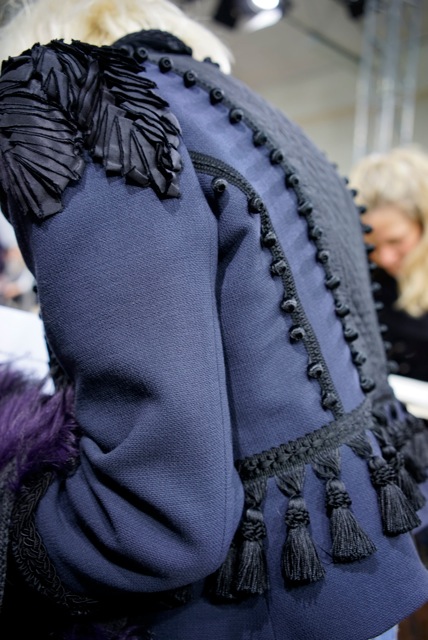
At another show Fran Burns, fashion editor at Vogue, had just got back from New York and was wearing this incredible military/Victoriana Marc Jacobs jacket. I was sitting behind her and took pictures of the detail as I admired it.
At the Chiltern Street Firehouse I was having a drink with Poppy Delevingne and looked down and saw her jeans with heels; again I loved that detail.
Same with Laura Bailey wearing a bright stripy Emelia Wickstead dress.
I like not knowing who the people are too. I’m kind of bored of always having to see a face attached to a look and owning it.
I took this of two great friends of mine who were having a natter on the edge  of isle saint louis. We were just loving being in Paris looking out across the seine. It was a lovely golden day.

So, for me taking pictures is like using instagram – it’s about sharing what I’m into as opposed to being ‘photographic’, or it being a craft. That’s also why I loved using this new Sony (Alpha 7R, FYI) camera. It’s a snapper, fits in the palm of your hand, and yet it takes beautiful, super-saturated, professional quality photographs – it’s a game-changing camera in fact, which suits me perfectly because my photography is more of an extension of my styling anyway; a way of recording how a detail can make all the difference –  and make me buzz!


Rachel Kelly on the consolatory power of poetry

Sixteen years ago I experienced my first bout of depression which was so painful that it seemed nothing could reach me. It was then that my mother and constant companion would sit by my bedside and repeat a line from Corinthians: ‘My grace is sufficient for thee: my strength is made perfect in weakness.’

These thirteen words helped reverse my negative thinking that nothing good could come from the illness. Instead, I would become stronger because of the ordeal. I often think of  depression as like a trapdoor opening inside me: I would repeat the words my mother gave me endlessly, mantra-like, when I felt in danger of falling through. They were at the heart of my recovery.

Since that first depressive episode I have continued to battle with depression, but thanks to drugs and therapy and above all poetry, I am keeping the Black Dog on a tight leash. When very low, I am still only well enough to absorb one phrase, be it from the Bible, which of course is full of poetry, or elsewhere. Favourites include the last lines of Arthur Hugh Clough’s ‘Say Not the Struggle Naught Availeth’, also famously quoted by Winston Churchill in his wartime speeches.

 ‘In front the sun climbs slow; how slowly,

But westward, look, the land is bright’.  

Another favourite is almost any line from Emily Dickinson’s ‘ “Hope” is the Thing with Feathers’ in which the poet compares hope to a bird. (Indeed there are many poems in which tiny birds are symbols of hope.) Hope is always there, even if it’s small and in your peripheral vision.

‘Hope’ is the thing with feathers –

That perches in the soul –

And sings the tune without the words-

And never stops – at all –

I began to discover that I was far from alone in finding poetry helpful in dark times. The novelist Daisy Goodwin has a ‘Poetry Doctor’ section on her website, while the philosopher Alain de Botton’s ‘The School of Life’ has recently begun courses in mindfulness and poetry. Meanhwhile, William Sieghart, founder of the Forward Poetry Prize writes ‘Poetry Prescriptions’ at various literary festivals with queues round the block.

Of course the healing power of words has a long history, dating back to primitive societies who made use of chants. By the first century AD, the Greek theologian Longinus wrote about how he believed in the powers of language to transform reality, to affect readers in deep and permanent ways, and to help them cope with the vagaries of their existence. Spool forward to the twentieth century and by 1969 the Association of Poetry Therapy was established in the USA.

Since I first discovered how helpful poetry could be, I’ve developed something of my own cottage industry in consolatory verse. Initially I swapped helpful poems with friends; now I am lucky enough to work with the Education Department at Wormwood Scrubs and several mental health charities, organising workshops which celebrate the healing power of poetry. My proudest moment came recently when one of the inmates at the Scrubs told me he had stayed up all night with the anthology of poems I co-edited for Canongate, ‘If: A Treasury of Poems for Almost Every Possibility.’  A section at the back recommends specific poems to try and help those who need courage, for example.  Feedback from readers – the anthology is now in its fourth edition – shows that this section is popular with others, too.

For me, poetry helps by recharging the spent batteries of my own language. Take George Herbert, for example – the Holy Mr Herbert who in my view almost certainly suffered from depression, though it would have been undiagnosed in the seventeenth-century when he wrote. His poem ‘Love’ begins:

‘Love bade me welcome; yet my soul drew back/

Guilty of dust and sin’.

The line ‘Guilty of dust and sin’ described exactly how I feel when I’m depressed: worthless, hopeless – guilty of ‘dust and sin’. What a perfect capturing! But Herbert quickly gives us a second, more compassionate voice: that of Love, who ‘bids us welcome’. Herbert knew exactly how to balance the darkness of his descriptions with consolation, which leads me further to believe he was a fellow sufferer. I’ve shared this poem over the years with many others who are depressed and it seems to work its magic on them too.

A powerful poetic line can diminish your loneliness, one of the worst characteristics of clinical depression. This was especially striking when I came across poems written hundreds of years ago which described a similar blackness to that which I was experiencing. It was very reassuring to realise that through the ages others had suffered.

Then there is the way poetry encourages your mind to focus on the present moment. Depression cripples your sense of time: your involvement in the present is overwhelmed by worries about the future or regrets about the past. But the complexity and subtlety of poetry requires you to concentrate in the present.  In this way, reading poetry has a similar effect to practicing mindfulness, which its proponent Jon Kabat-Zinn describes as “paying attention in a particular way: on purpose, in the present moment, and non-judgementally.” Indeed, some therapists are now routinely using poetry as part of their mindfulness courses.

Robert Frost, demonstrating my point perfectly, put it far better when he said that a poem can be a ‘momentary stay against confusion.’ That’s what happened all those years ago when my mother sat at my bedside and spoke the words aloud.

Now I know those lines and many more besides: a golden store, learnt by heart, to be used as and when. Everyone collects their own store of gems: the wonder of poetry is that we all find different words comforting. One friend introduced me to this from the late lamented Christopher Logue: it never fails to cheer her up.

 ‘To a Friend in Search of Rural Seclusion’:

‘When all else fails,

 Try Wales’.


It’s goodbye for now…

The team at A Little Bird are taking a break to recharge and make some exciting changes behind-the-scenes. We look forward to seeing you again soon.

CONTINUE TO SITE

A Little Bird Told Me…

SIGN UP TO OUR NEWSLETTER TO STAY IN-THE-NOW. ONLY LANDING IN YOUR INBOX ON THURSDAY MORNINGS AT 11AM.