Recipe: Christmas Cake

It’s that time again. Unlike many gateaux, the Christmas cake doesn’t require the finest of baking hands. But to be really delicious it needs time to drink (don’t we all). If you make your cake now you’ll have time to feed it over the next few weeks. More to the point: if you make your cake now, you’ll have made your cake. Honestly, it will taste better than any bought one, however posh. Any one who sells a Christmas cake simply won’t have included enough of the more expensive ingredients, like booze, and really good quality dried fruit. Icing the cake is not necessary (you can always put some whole almonds on the top instead), but quite fun.

We have a competition in our house for the best Christmas cake, and so have tried and tested many recipes. Our favourite is Nigel Slater’s in The Kitchen Diaries, which we have adapted, because Nigel uses hazlenuts and we think almonds are better in a fruit cake, and he includes figs and prunes, which, on much reflection and after great debate, we think are best left out. Here is the winning formula.

One note: for a really good cake you need to soak the fruit the night before baking commences.

Winning Christmas Cake

For the cake:
900g dried fruit – we do about three quarters sultanas, raisins, and currants to a quarter apricots (cut them up), sour cherries (available from most supermarkets) and cranberries
250g butter
125g light muscovado sugar
125g dark muscovado sugar
100g candied peel (Italian delis sell the best stuff by far. Buy whole quarters of orange or lemon peel, then cut it up yourself, as finely as you like it.)
3 large free range eggs
65g ground almonds
100g whole almonds
Irish whiskey or brandy
the zest of one orange and the juice 4 oranges
the zest of one lemon
250g plain flour
half a teaspoon baking powder

For the Icing:
500g Marzipan (or more if you like a really thick layer)
A couple of boxes of bought fondant icing (again, the amount depends on how elaborate your decorations will be).
Apricot jam (which will act as glue)


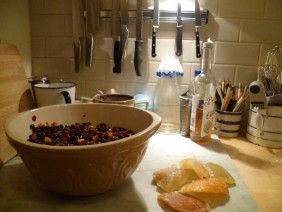
Soaking: The night before you intend to make the cake, soak all the dried fruit in the juice of three oranges and a good healthy glug of either the Irish whiskey or brandy. About three tablespoons will do it, but I slosh in a bit more.
Lining: The only other time consuming job you now have is to line the tin. You need a deep 20cm round or square tin with a removable base. You can get away lining it, bottom and sides, with a double layer of greaseproof paper. Butter the tin a bit to make it tacky so that the paper sticks to it, and have the paper rise up above the sides of the tin a few centremetres, so the cake has room to rise. This is the minimum amount of lining you can get away with. I prefer to go the Krypton Factor route and line with cardboard too, as this really ensures the cake won’t burn round its edges. You can keep your cardboard moulds from year to year. Extra brown wrapping paper, doubled up, would be another option if you can’t find any cardboard. I also put a double layer of greaseproof paper, with a whole cut out in the middle (so steam can escape) on top of the wet cake mix, to protect it from burning on top. I think it’s definitely worth the hassle of doing all this. It’s disappointing to make a cake and then find that the sides and top are burnt.

Heating: Set the oven to 160° C.

Making: Beat the butter with both sugars until the mixture is pale and fluffy. This is infinitely easier with a mixer. Slow down the mixer to add each egg, one at a time. Speed it up again between each egg and let it really mix together – for longer than you think necessary. This helps to prevent the mixture curdling. If it does curdle, don’t worry. It will all come together again when you add the flour.

Meanwhile add the ground almonds, whole almonds, candied peel, lemon zest, orange zest, the juice from your last orange and another generous slug of your booze to the dried fruit. Give it a good mix. Then mix this into the butter, sugar and egg. It’s best to do this by hand.

Finally, add the flour and baking powder and fold in lightly. Dollop the mixture into the lined tin, smooth the top gently and put into the oven. Bake for an hour, then turn the heat down to 150° C and cook for another hour and a half. Make sure the cake is done when the time is up by inserting a skewer. If it comes out clean (if a bit crumby), then you are fine. If there is raw cake mix clinging to it, put the cake back in the oven for a little longer. All ovens vary which is why you need to check your cake. Let the cake cool in its tin before removing it from it’s tin and brown cardboard/ paper casings.

Feeding: Feed it once a week until you come to ice it (as near Christmas as possible, though remember that you have to do a layer of marzipan first and that needs to dry out for a few days before you add the icing). Skewer holes all over the cake and spoon yet more booze over and into it.

Icing: I used to make my own marzipan and icing. What a faff. Now I buy Crazy Jack marzipan from the whole food shop, which is good and natural (own brand supermarket stuff is fine too), and a lot easier to roll. Ready to roll fondant icing, which you can buy easily, is by far the easiest icing to use and tastes just as good as homemade stuff. It’s just icing sugar and egg whites after all.

Put your cake on the stand or board you are going to keep it on. Lightly dust a clean working surface with sifted icing sugar and roll out the marzipan to fit your cake. Do this in several stages. First measure your cake using a piece of string. The top of the cake will be one square or circle of marzipan. You can do one long low rectangle to wound around the sides or don’t worry if you’d rather do two smaller ones. It is easy to smooth all the edges. Gently warm the apricot jam in a small saucepan and if it’s got chunks of apricot in it, sieve them out. Then paint the cake with the jam. Drape the marzipan that goes on the top of the cake first and smooth it down so that there aren’t any air bubbles or lumps in it. Use a palette knife or a blunt knife to do this. Cut off any excess marzipan. Then cover the sides and do the same smoothing process. It’s all easier than it sounds. Leave the cake with its marzipan coat on for a few days in a cool place (preferably in a tin, or wrapped up in greaseproof paper and tin foil) or a week if you have the time. This allows the oil from the marzipan to dry out so it won’t stain the icing.

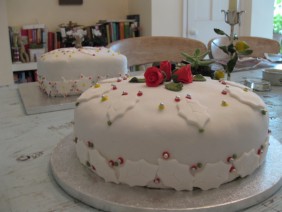
When it comes to icing the cake, follow the same method as for the marzipan. You can get Christmas themed cutters to make things like holly leaves. Bought ‘writing icing’ or flowers makes it easy to squeeze or plonk on a bit of colour. Here, below, is last years effort.
Food: Swedish cinnamon buns

We had to chuckle a couple of months ago when Marks & Spencers announced that Swedish cinnamon buns were the ‘new’ fairy cakes. Being half Swedish, we’ve been eating these buns as long as we can remember and the smell of them freshly baked is heavenly. It got us thinking though, where can you buy a good Swedish cinnamon bun in London? At the Nordic Bakeries in Soho or Marylebone, they are made using a rustic Finnish recipe making them a little heavier than Swedish buns, but still with a good cinnamon bite. At Totally Swedish, in Barnes or Marylebone, they are of the classic Swedish variety, available to buy either frozen or fresh, the latter being made twice a week. Our favourite, though, are those at The Scandinavian Kitchen on Great Titchfield Street which have just the right balance of cinnamon-butter filling to bun bread. In fact we love them so much we decided to ask The Scandinavian Kitchen for their recipe (see below), so we could cook them at home. The ingredients are all fairly basic apart from the pearl sugar (or Pärlsocker in Swedish), which you can get at their shop near Oxford Circus, online here, or at the annual Swedish Christmas Fair held at the Swedish Church this weekend, which sells all kinds of traditional Scandi food as well as great, un-gaudy Christmas decorations (see www.swedishchurch.com for more details). Happy baking!

Swedish Cinnamon Buns
Makes around 40 buns

For the best results, don’t be stingy with the filling and don’t try to use low fat anything: whole milk, good quality butter… We also prefer using fresh yeast, but if you can’t get hold of any, you can use dried (see footnote).

The dough
50 g fresh yeast
1000 g plain bread flour

85 g caster sugar

1 egg
150 g unsalted butter
500 ml whole milk
½ tsp salt
1 tsp ground cardamom

Filling
150g butter (nice and soft)
4-5 tsp ground cinnamon
85 g sugar (we like to use brown sugar)

Decoration
1 egg for brushing
Around 100 g of pearl sugar for decoration (see online shop here)


Melt the butter and add the liquid (milk) – check the temperature (should be between 37-46 degree Celsius for optimal yeast). Add the yeast and stir.

Once the yeast has dissolved, add the egg, sugar, salt, cardamom and most of the flour (hold a bit back for kneading). Work the dough until it stops sticking and has a shiny surface – probably around 10 minutes by hand. Keep kneading, it makes for a better bun.

Place the dough in a nice warm place for around 30 minutes or until it has doubled in size. Place the dough on a floured surface and work through the rest of the flour.

Cut the dough in half and roll out each piece in a rectangular shape, around 30 cm long and 12-15 wide. Butter the whole piece liberally and dust over with the cinnamon and sugar. Roll each piece lengthways so that you end up with a long sausage looking roll. Cut 2 cm big bites and place them carefully on baking trays (take care to keep them separated as they will rise). For ease, you can add large muffin cases if you wish, but this is not essential. Let the buns rest for another 30 minutes until doubled in size. You should get between 34-40 buns out of this batch.

Brush gently with egg and pour over a bit of pearl sugar on each bun and then bake in the over on 220 degrees (fan oven) for about 8-10 minutes (turn the heat down a bit half way if you feel they are getting too brown). Let them cool down under a clean tea towel – this will stop them going dry immediately.

Footnote: whilst fresh yeast is available at Scandi Kitchen, in some health food stores and some super markets, you can use 2 x 7g sachets of the instant dry yeast instead – just make sure to add this to the flour/dry ingredients and NOT to the wet mix.

Restaurants: Cuisine de Bar by Poilâne

There are several hot new restaurants opening this autumn, from Mishkin’s, the latest offering from Russell Norman, the brains behind the Polpo and Polpetto, to The Delaunay from Chris Corbin and Jeremy King of The Wolesley. First up though is Cuisine de Bar from Poilâne, the delicious Parisian bakery and family business set up in 1932 that used to supply bread to Dali and Man Ray, and still makes it just the same way today, entirely by hand. Their first eating venture outside of Paris is just behind Sloane Square and opened at the beginning of November. With dark green walls, white-washed floors and a small tree in the middle of this light airy space, there’s a Scandi/NY feel to it and a delicious smell of bread that envelopes you as you walk through the door. You can sit at the bar, at bigger tables or at cute singlettes (a seat and table all to yourself) and order from an all-day dining menu. There’s toasted brioche for breakfast, an array of tartines to order for lunch (from Welsh rarebit to Mackerel) followed by classics like apple tart, and light supper dishes such as smoked duck burger. If you like the Daylesford Café in Pimlico but with a French twist, then you’ll love Cuisine de Bar.

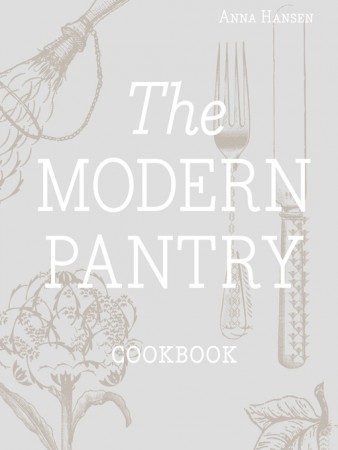
The Modern Pantry Cookbook by Anna Hansen

Sometimes you want a cook book that tells you how to do the best beef stew or make a great chocolate pud, and then there are nights when you want to make and taste something new and fresh and zingy and different. That’s when you reach for Anna Hansen’s The Modern Pantry Cookbook.

Hansen, a cook from New Zealand, named one of the top five female chefs of the decade by the Telegraph, worked for Fergus Henderson and Peter Gordon before opening The Providores in Marylebone, and more recently the hugely popular The Modern Pantry in Clerkenwell. The title of both book and restaurant is apt because Hansen is a cook who combines all kinds of flavours, thinking nothing of giving a Japanese dish a Turkish twist for example, and you may have to update your own pantry somewhat before you get cooking (pomegranate molasses, white miso and mirin are all Hansen essentials).

It’s worth it. We love the book, and favourite recipes so far include Aubergine Dengaku (a version of the classic Japanese dish which we’d never made at home before and yet it’s easy peasy), Beetroot, Lentil and Mint Salad with Pomegranate Molasses and Orange Dressing, Cod with Clams and Chorizo (a fab dish if you’ve got people coming for supper), and Grilled Lamb Chops with Smoked Anchovy Salsa.

Francesca Martin

Former Features Director at Harper’s Bazaar and Guardian Arts Diary Editor, Francesca co-founded A-LittleBird in 2010.  She is half Swedish and loves Ernst Kirchner, cross-country skiing, salty liquorice and David Sedaris.

Recipes: the fail-proof summer quiche from Rose Bakery

We’ve always been impressed by our friends who could whip up a tasty quiche in no time at all. So we were thrilled to discover a recipe from Rose Bakery in Paris that we’ve cooked again and again this summer and has never let us down. This is a basic recipe to which you can really add anything – we’ve done courgettes, asparagus and parmesan (a handful of strong cheese gives it more flavour); ham, peas and Gouda cheese and just plain cheese and leeks – all delicious, though we say so ourselves! Just cook the ingredients lightly first before adding them to the mix (we tend to cook the leeks in butter but leave peas and asparagus plain). We’ve included the recipe for making the pastry, but if we’re in a rush we just use a ready-made short crust pastry that is easy as pie to roll out and bake.


Ingredients:

Pastry:

1 cup (170g) of plain flour (not fine cake flour, but something stronger approaching bread flour)
large pinch of salt
80g of good quality cold unsalted butter (Normandy if possible)
1 egg yolk
80 ml of cold water

Mixture:

500 ml of single cream
4 eggs
1 egg yolk
pinch of salt, black pepper and grated nutmeg

For the pastry, put the flour, salt and butter into a food processor for about 5-8 seconds. Don’t worry if it isn’t all mixed up. If you are doing it by hand, mix the flour and salt and cut the butter into pieces which you then mix together with your fingertips. Then create a well in the mixture into which you pour a third of the water and mix together quickly with a fork (add more water if you need it). Then gather together the mixture with your hands (make sure they are cold, run under cold water if necessary). Don’t knead, just make sure it isn’t either too dry or too sticky. The less you handle the dough, the lighter it will be. Then wrap in cling film and put in the fridge for anything from 30 minutes to 8 hours (or you can freeze it for later).

Then, preheat the oven to 180°C/350°F and grease a 28cm/11 inch quiche tin (you can use a thick or thin one depending on what type of quiche you want) with butter.

Take the dough out of the fridge and roll it out, dusting with flour so it doesn’t get stuck. When it reaches a thickness of about 4 mm, put it in the tin. Don’t stretch it and add a little extra if you can as it will shrink.

Bake the quiche pastry adding in a weight (you can use anything such as foil filled with beans) for about 25-30 minutes. The pastry should be dry and just turning golden.

For the filling, mix the single cream, eggs and egg yolk together. Add a pinch of salt and pepper with some grated nutmeg.

If you are using ingredients such as leeks, it is best to then line the pastry with these and then add the cream mixture to make sure that everything is evenly spread in the quiche.

Then put back into the oven and cook until the mixture becomes firm and doesn’t wobble – usually about half an hour.

Food & Shopping: Maltby Street Market

This is what we wished for in terms of ultimate food shopping: Borough Market but without the crowds. Borough is fabulous of course if you can get there first thing on a Friday morning, or late in the afternoon, but come Saturdays, which is when most of us have time to peruse a market place tasting cheese and buying single estate chocolate, it’s like Oxford Circus at Christmas – impossible.

But guess what? Just down the road, under some railway arches in Bermondsey’s Maltby Street, there’s a small but perfectly formed version of Borough every Saturday from 9am to 2pm, and, whisper it, there are no crowds at all. It started when Monmouth Coffee, who have their warehouse there, decided to open their doors and sell coffee to anyone who might be milling about. Before long, lots of folk were – and not just for the delicious coffee either. Fern Varrow, of the Black Mountains (one of the best organic farms in the country, and a favourite of Nigel Slater’s) quickly set up stall selling wonderful vegetables, fruit, lamb and beef, and so did others, all of them excellent purveyors of really delicious things to eat, including:

St John – the best bread in London. Do also make sure you have one of their Eccles cakes and a custard donut.
Kappacasein – raclette and toasted cheese sandwiches from heaven.
Neal’s Yard Dairy – unbelievably good selection of British cheeses, oatcakes and things like veerjuice, which are hard to get anywhere else.
The Ham and Cheese Co – fab Parma ham, mozzarella, salamis and parmesan.
The Kernel Brewery – really locally brewed beer – as in made right there under the arches.

Plus loads more great stuff including cakes, ice cream, fruit, wine, eggs, pickles and other delicacies. It’s become our favourite place to go on a Saturday morning, not least because the stall holders are so knowledgeable and passionate about what they are selling, and have time, while you sip your coffee or chew on a pain au chocolat, to give you a recipe or tips on the best way to eat or cook whatever you might be buying. So we browse, we shop and most of all we eat – a lot. And we feel happy.

Three Moro cookbooks

If you’ve ever been to Moro or Morito restaurants, or even better had the pleasure of tasting Sam and Sam Clark’s food at festivals such as Port Eliot, you’ll know how delicious their food really is. To celebrate ten years since the publication of their first cookbook – how time flies, Moro opened in 1997 but it is still one of our favourite restaurants – they are bringing out a special paperback edition of all three cookbooks next month. The first book, Moro, reveals the secrets behind their most popular restaurant dishes; the second, Casa Moro, has recipes from Andalucia where they have a home and the third, Moro East, followed a year in the life of their allotment.

And to give you a mouth watering idea of what the books are like, they have picked out some of their favourite recipes such as scrambled eggs with prawns and asparagus, lamb with chickpea puree and hot mint sauce and fresh spiced cauliflower.


Kempton antiques market

When we heard Laura Bailey and then India Knight raving about this antiques market in Sunbury near Twickenham, we had to check it out ourselves. Held twice a month, we went this Tuesday and wow, it really is a find. For a start, it’s huge with over 700 stalls, some of them (particularly the jewellery) inside, but the better stalls by far are outside. A sort of French brocante crossed with a countryside flea market, it has sellers specialising in practically anything you could wish for. French linen? We spotted at at least 3 stalls with a fabulous and not too expensive selection. Outdoor furniture, including vintage plant holders? You got it. A selection of religious statuary? Vintage star mirrors, rocking horses and taxidermy? All here. We got there just before 8am but apparently you have to be an early bird and get there at around 6.30am to get the really good stuff. Be warned, though, it’s hard to come away empty handed!

Bocca Cookbook

Jacob Kenedy, the chef at the hit Soho trattoria, Bocca di Lupo had one aim: to bring regional Italian cooking to London. With the recent publication of the book, Bocca, the promise is that we too could taste authentic Italy at home. We have quite a few Italian cookbooks in our kitchen but none has ever quite delivered that taste of the oh-so simple looking delicious plate of Tuscan pasta. So we approached this book with caution. But oh joy, it really does work. Whether it is linguine with clams, Venetian tagliatelle with ragù or hearty risotto, our dishes really do seem to have a more authentic flavour. Some of the recipes seem a little ambitious (we don’t think we are quite up to baroque Venetian desserts) but maybe what makes the book work is that Kenedy is only part Italian – he studied natural sciences at St John’s College, Cambridge whilst working every holiday in the kitchen at Moro with Sam and Sam Clark. For the book, he spent a year travelling around Italy amassing recipes and the result is something everybody can appreciate and more importantly, recreate at home.

The Ginger Pig Meat Book

Another day, another excellent cook book. We ignored this book when it first came out in early May because we’ve already got one or two good books that focus specifically on meat, which we don’t eat massive quantities of anyway. But in fact this book is brilliant. It’s now the one we reach for whenever we are wondering what to cook for supper. And yes, it is all about meat – The Ginger Pig is a famously good butcher just off Marylebone High Street and in Borough Market – but its recipes provide you with solid, hearty, delicious whole meals, like Navarin of lamb or Asian beef curry, The ultimate burger or Poached chicken and noodle pot, rather than the overly carnivorous cheffy fare that constitute many other meat books. The recipes are laid out simply and well month by month (meat is much more seasonal than many people realise), with each month having an introduction about life on the farm where The Ginger Pig meat is reared, and it encourages readers to use every cut of meat simply by providing appropriately mouth watering recipes. The photographs are both evocative and useful, showing pictures of the animals alive and happy as well as the finished dishes, and there are great photo-guides illustrating how to carve or joint a particular piece of meat, all of which is great of course, but finally the reason we love this book so much is because it is full of things we want to eat every day and it explains how to cook them really, really well.

It’s goodbye for now…

The team at A Little Bird are taking a break to recharge and make some exciting changes behind-the-scenes. We look forward to seeing you again soon.

CONTINUE TO SITE

A Little Bird Told Me…

SIGN UP TO OUR NEWSLETTER TO STAY IN-THE-NOW. ONLY LANDING IN YOUR INBOX ON THURSDAY MORNINGS AT 11AM.